Lighthouses
I have drawn the same building six times without meaning to. It started as a building. It did not stay one, and then it came back as one.
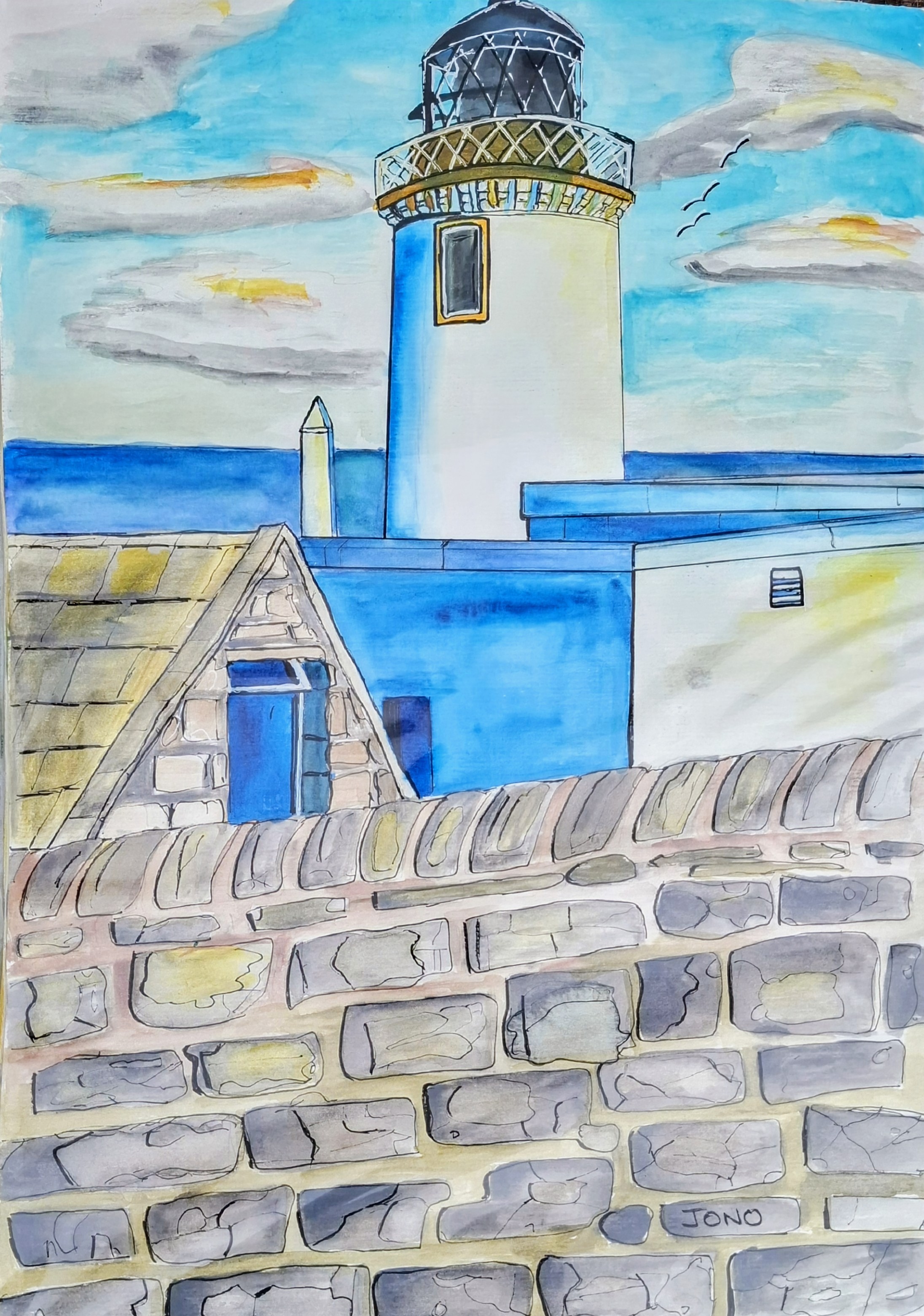
Dunnet Head Lighthouse is the one that was actually there. Caithness, the top corner of the Scottish mainland, and the light sitting behind a drystone wall that takes up half the picture. I painted it the way I found it: grey stone, cold sea, muted, the gulls in the right place. There is no invention in it, and that was not what it was for. It is the reference. Everything after it is what happens once you stop looking at the thing and start using it.
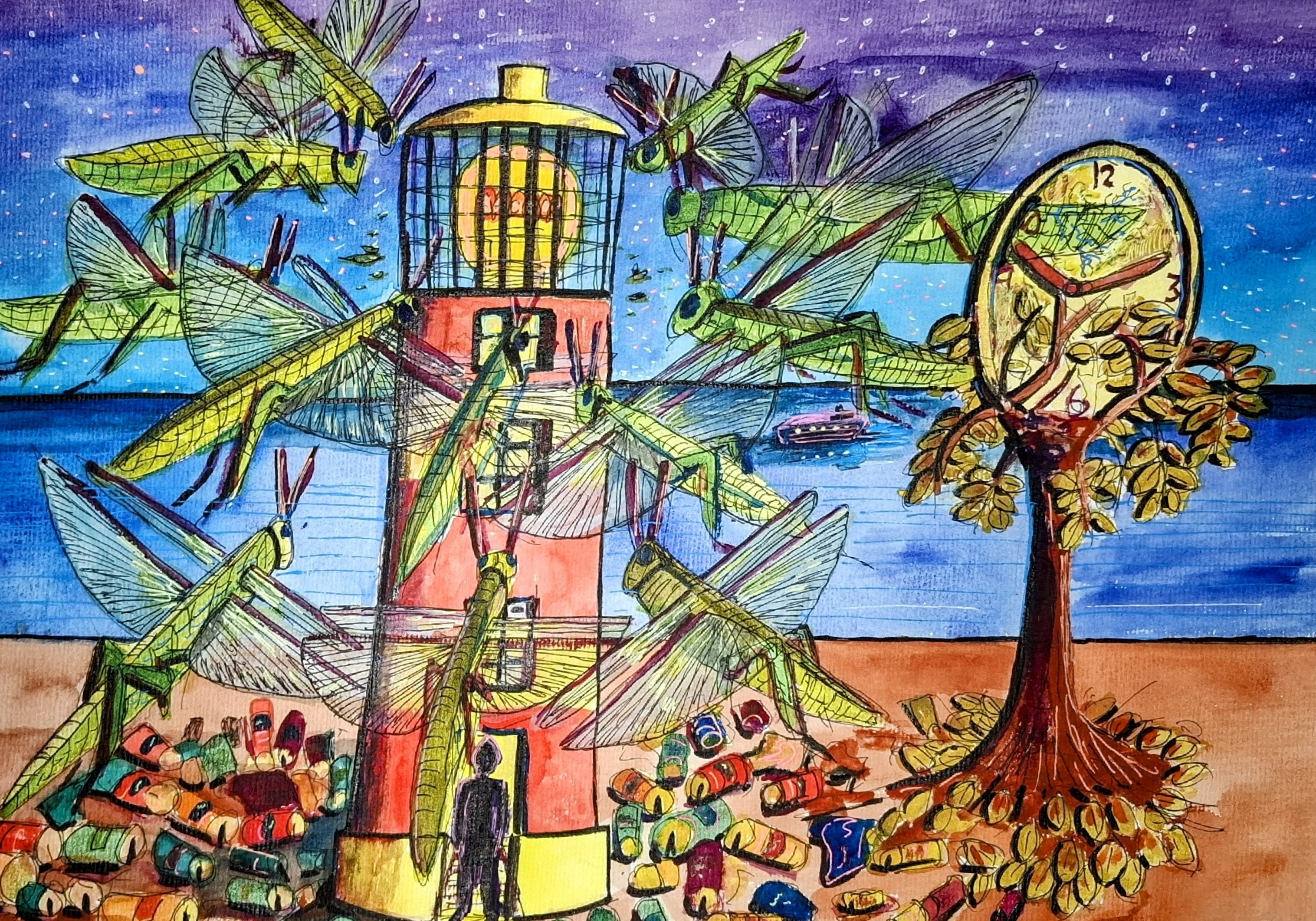
Light Attraction is the first departure. A lighthouse at night, red and yellow, and the air around it thick with grasshoppers coming in on the beam. Underneath, on the sand, the ones that already came. Husks in colour piled up around the base, a clock hanging melted in a tree on the right, one small figure standing in the doorway watching it happen. The light does its job perfectly. It is visible for miles and everything that sees it comes. That is the problem with being a beacon. You do not get to choose what you attract, and the things that arrive are not always saved by arriving.
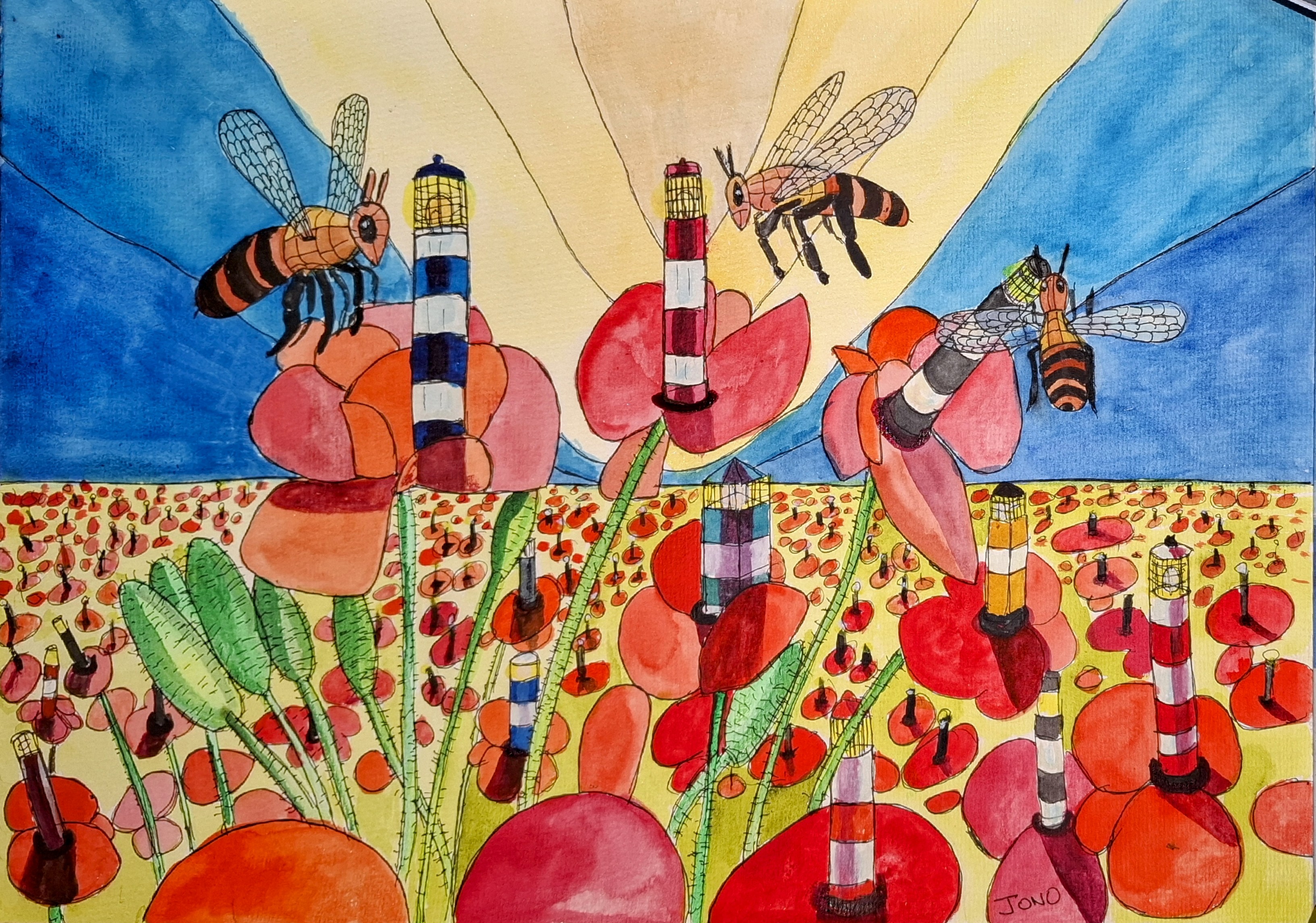
Pollinating Light takes the same idea and makes it agricultural. A poppy field running to the horizon, and every poppy has a lighthouse growing out of its centre where the stamens should be. Bees work the field, moving tower to tower. Striped red, blue, yellow, black, no two the same. This one is my favourite of the group because it turns the lighthouse into a crop. Something cultivated, propagated, deliberately spread. In Light Attraction the light draws things in and they die at the foot of it. Here the light is being farmed, and the bees are busy making more of it. Same object, opposite economy.
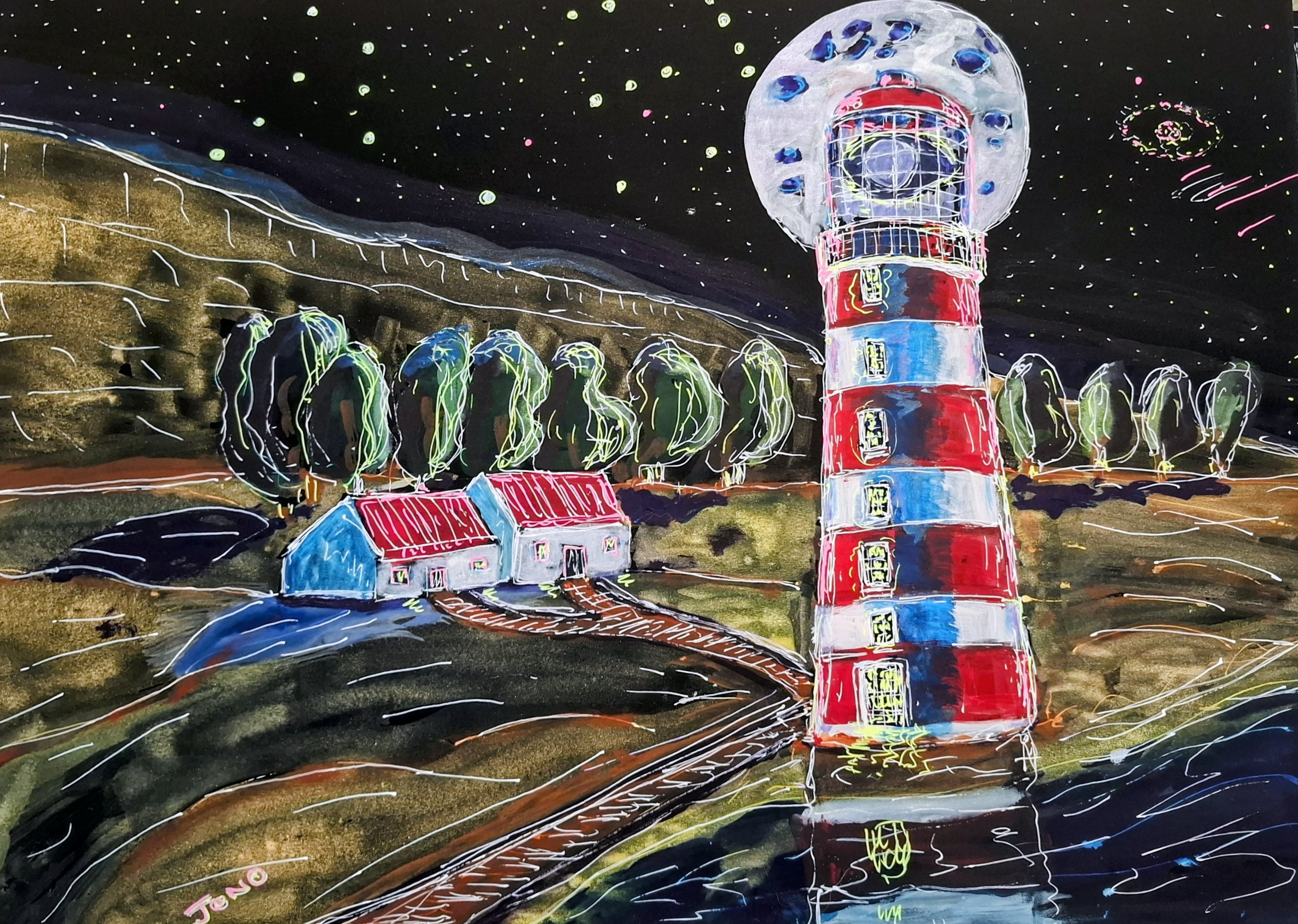
LightHouse is the pun made literal, and I am not going to pretend it is not a pun. A banded tower at night with the full moon sitting directly behind the lamp room, so you cannot say which of the two is doing the lighting. Two keeper's cottages below with red roofs and the windows lit yellow, a track running up to the door. It is drawn in white pen over dark washes, so the picture is line on black rather than paint on white, which is the reverse of how I usually work. The title is a house made of light, or a lighthouse made into a home, and the painting declines to settle it. Someone lives there. That is the part people forget. A lighthouse is a warning to everybody else and an address to one family.
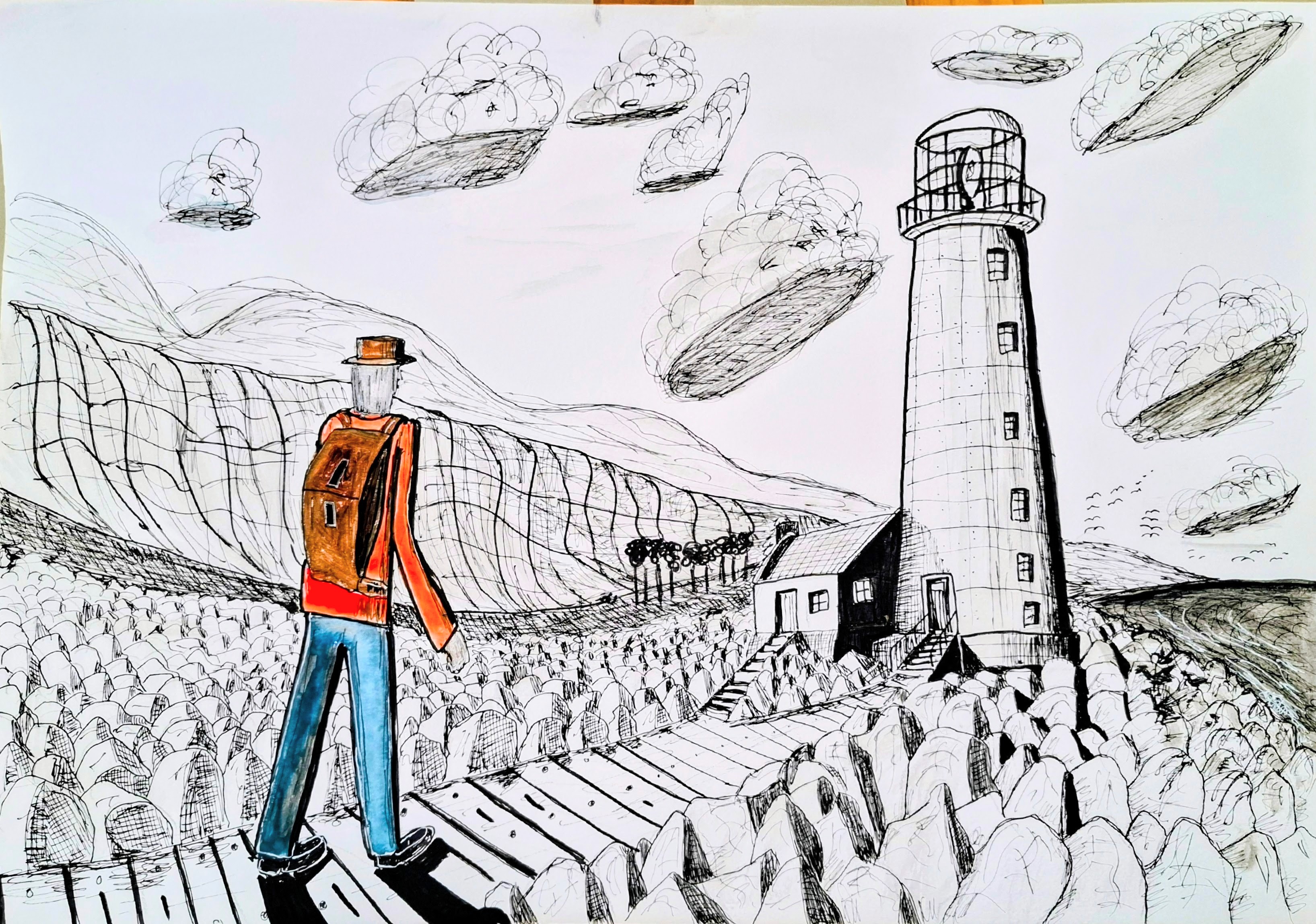
A Lighthouse to Know Where belongs to the Know Where series as much as to this one. The pilgrim walks a boardwalk across a field of stones toward the light on the headland, the saucer clouds massed low over the hills, and he is the only colour in a black and white drawing. A lighthouse is the honest version of a destination. It is not the end of the journey. It tells you where you are, warns you off the rocks, and then you keep going.
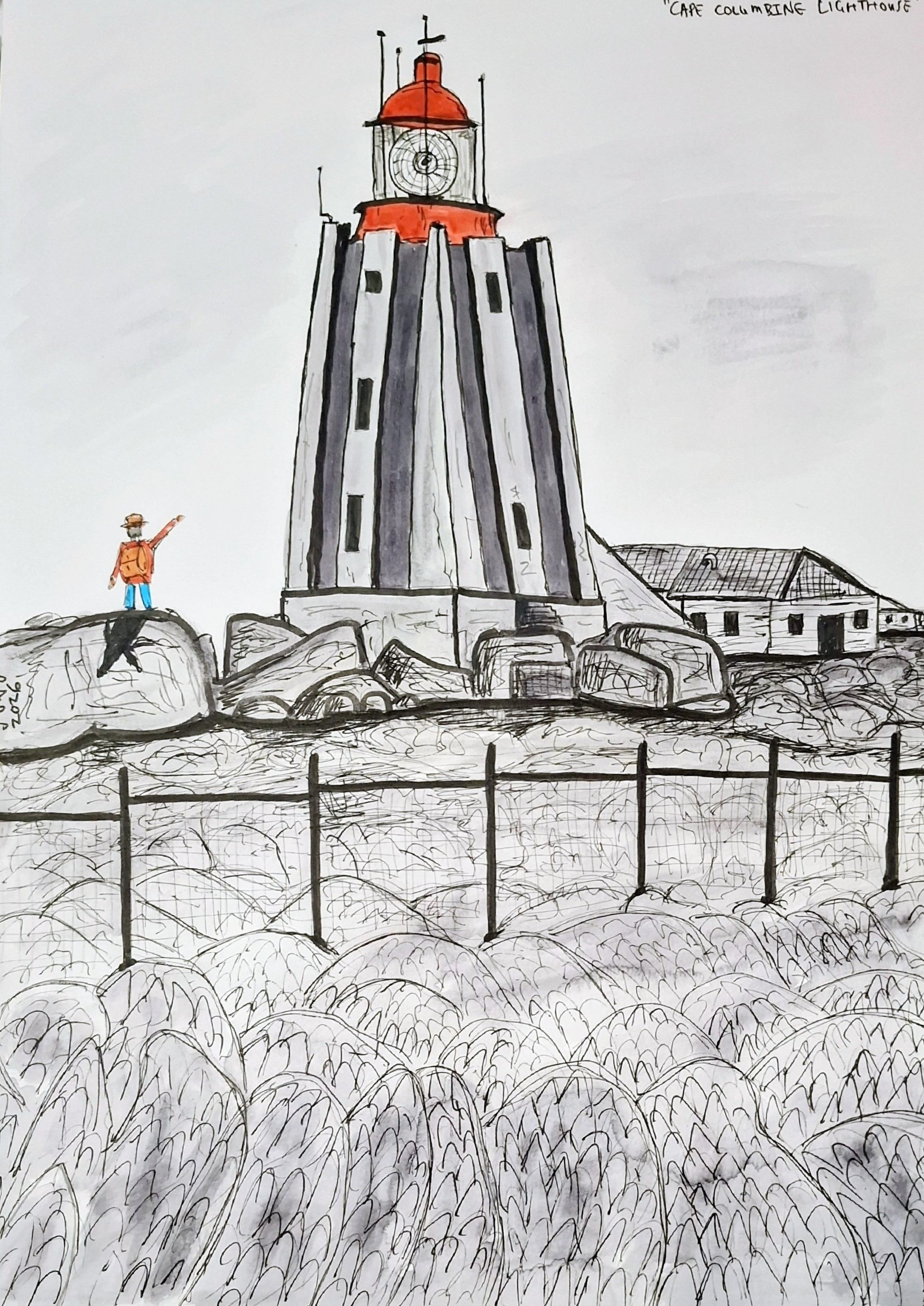
Cape Columbine Lighthouse goes back to a real one. Paternoster, on the West Coast, the squat fluted tower sitting straight on the granite with the red lantern on top and the keeper's houses tucked in to the right. A wire fence runs across the middle of the sheet, and the whole foreground is scrub, drawn as thousands of small scribbled mounds that took longer than the lighthouse did. The title is written along the top in capitals because that is how it arrived, as a note on a sketch rather than a painting with a name.
The difference from Dunnet Head is the man on the boulder. Same orange pack, same hat, the only colour on the page, out on the rocks to the left with his arm up. He is waving. That is not something he does anywhere else. He walks in every other drawing, and here he has stopped and raised an arm, and the sheet does not say who to. There is a watercolour from the same year, Paternoster, that puts him down on the beach path below the village, walking beside someone. Read the two together and the wave acquires a direction.
Six pictures, one building, and what keeps changing is what I want from it. A record. A trap. A crop. A home. A mark to steer by. Somewhere to stand and wave from. The lighthouse is worth drawing because it is the rare structure that is entirely about other people. It exists to be seen from somewhere else, by someone who is not there yet. Nobody builds one for the view from the top.