The Know Where Series
Three paintings and seven drawings, and one journey running through all of them. It was not planned as a set. It arranged itself into the shape of the same idea: you set out, you do not know where you are going, and the road does not care.
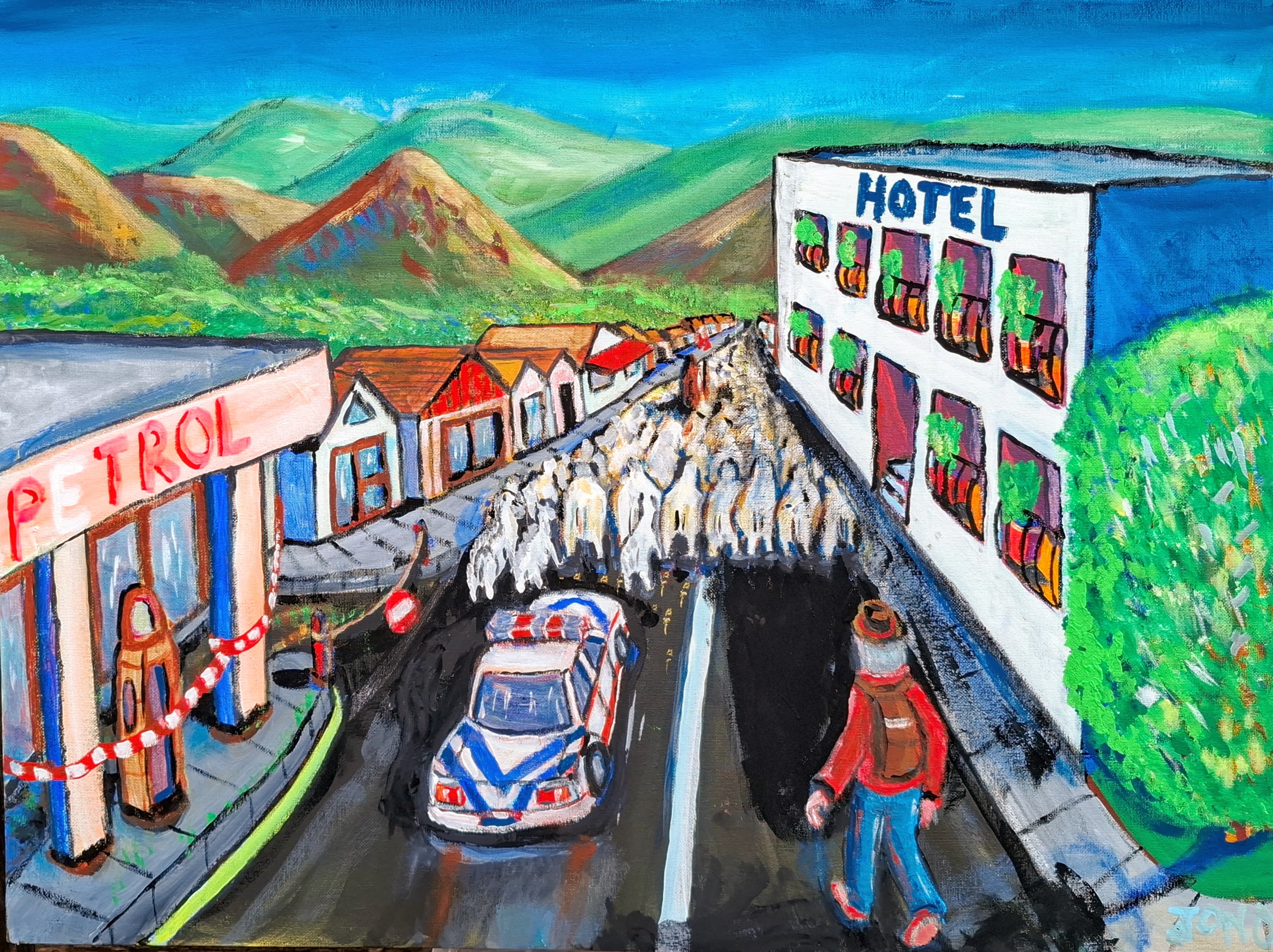
On the Way to Know Where is the painting at the top of this page. It came last, and it is where the series has arrived. Everything below it is how it got there.
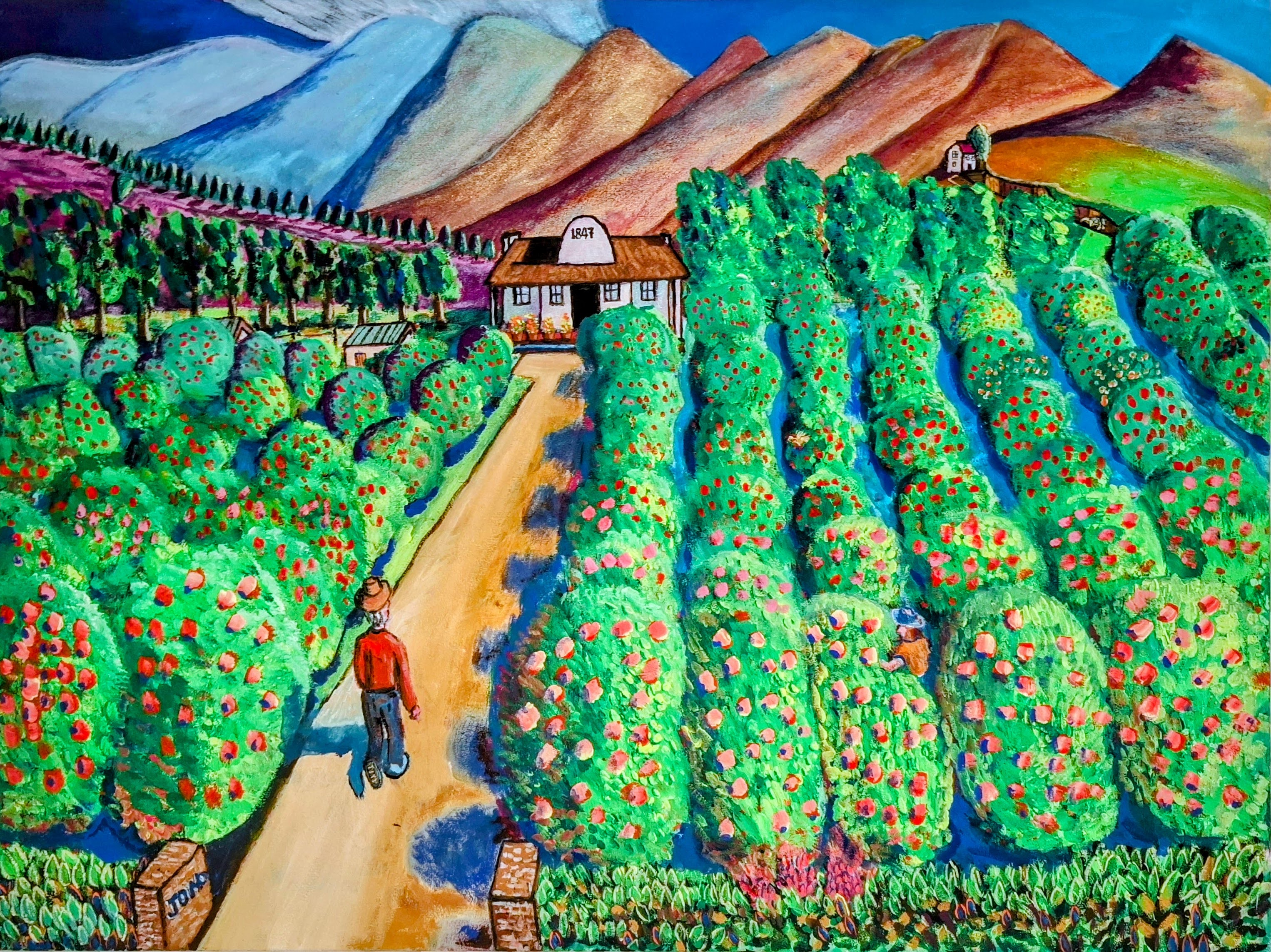
The Road to Somewhere (Part One) is the destination, or at least the destination I want. Abundant fruit, colour, a beautiful house at the end of the road. It is aspirational rather than documentary. The R62 gave me the bones of the composition, but the place in the painting is better than the place in the photograph, because the photograph was never the point. The "Part One" was never decorative either. The road carries on past the frame, in every direction, and something unexpected is already on its way.
That painting fixes the destination. The drawings put a person on the road to it, and from that point the series stopped being about the place and started being about him.
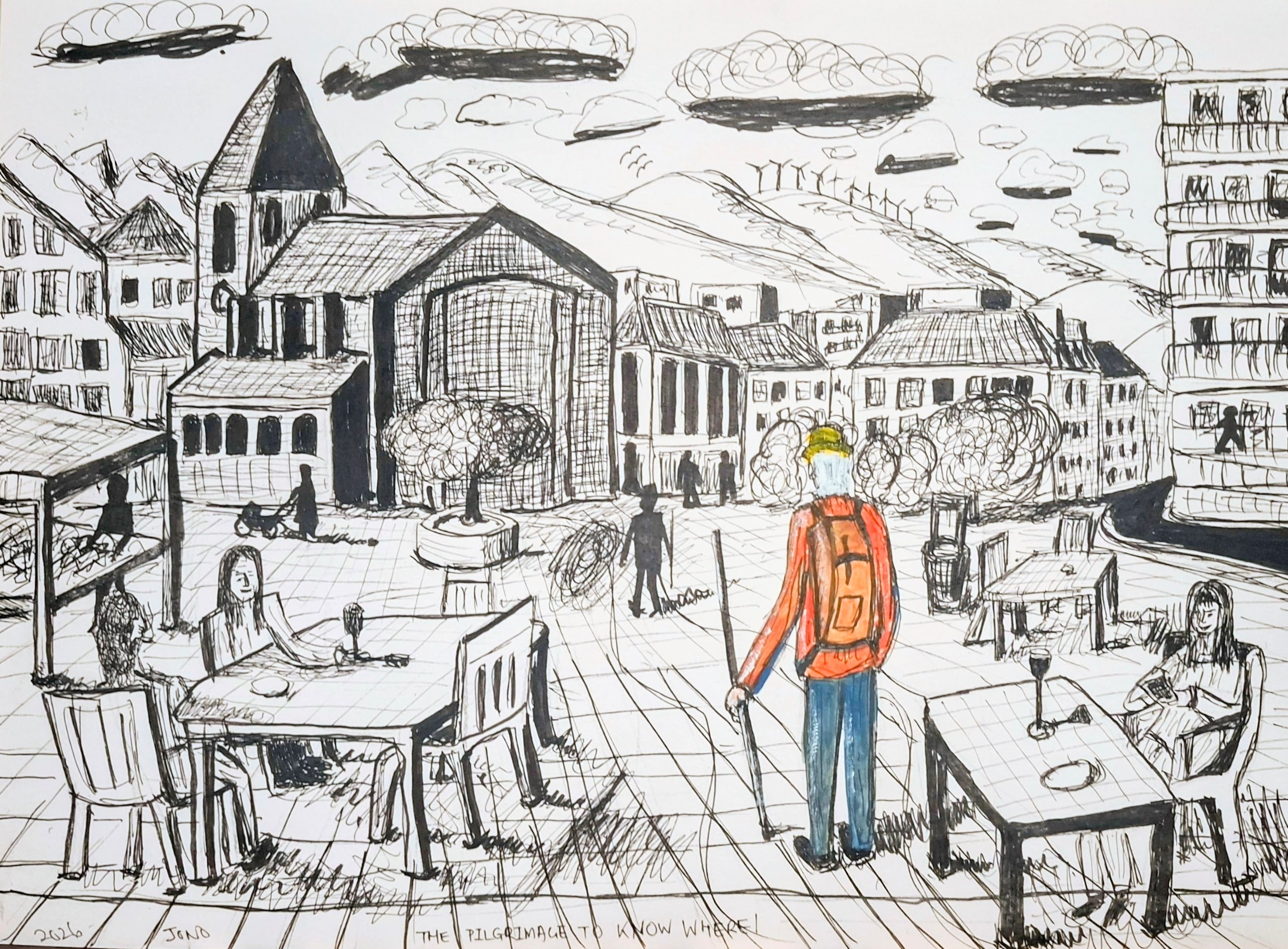
The Pilgrimage to Know Where is the first drawing. A pilgrim stands in the square with a stick and a pack, the cathedral ahead, the mountains behind it, the cafe tables carrying on with their ordinary afternoon. He has stopped. Everyone else is seated or moving, and he is the only one facing the distance.
I drew it in ink and left the whole scene in black and white, except the figure. He gets the watercolour. That was the decision the drawing turned on. The road and the destination belong to the painting. The pilgrim is the one carrying all of it, so he is the one who gets the colour.
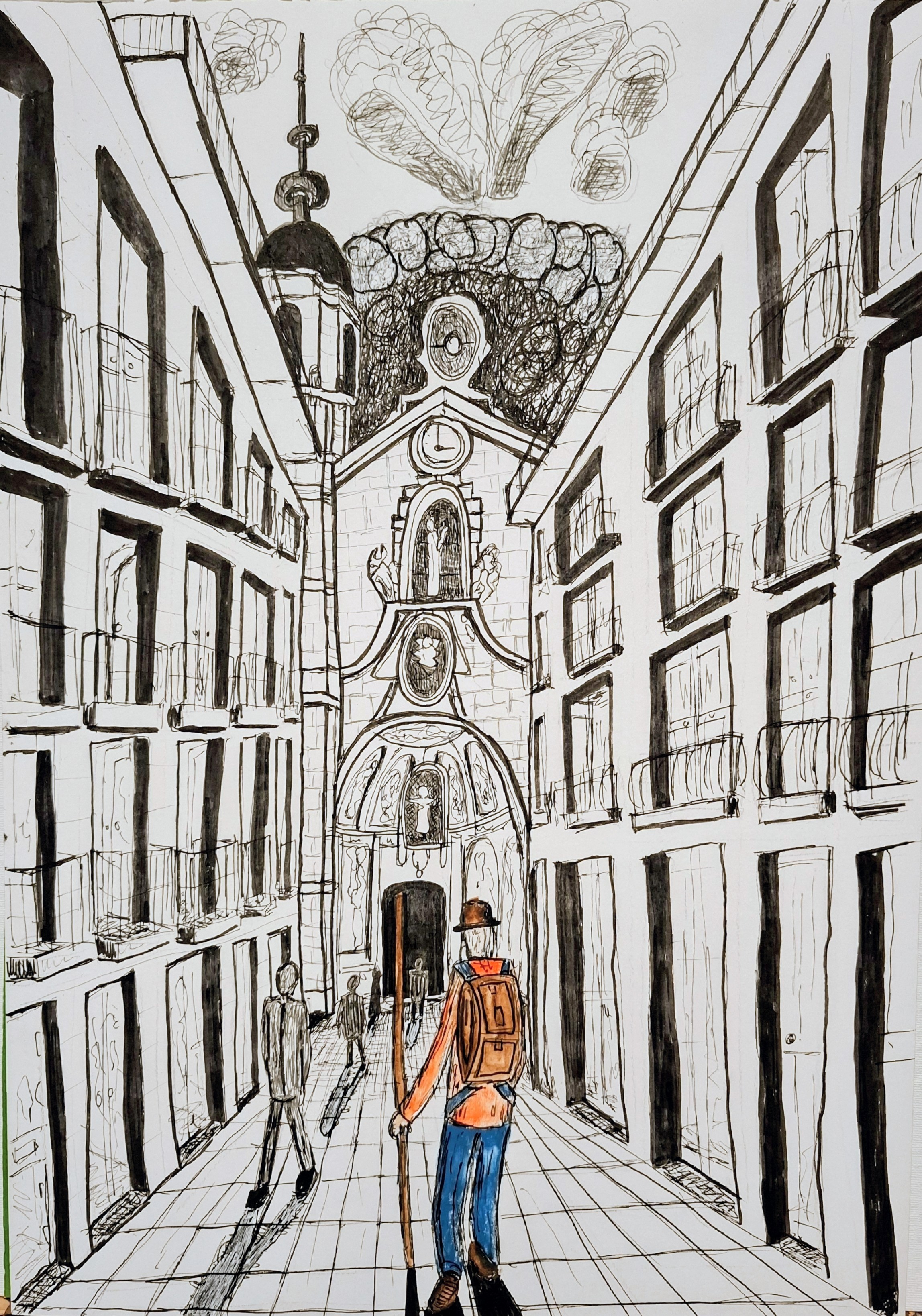
The Pilgrimage to Know Where Too is the second drawing. The first put him in the open square, the cathedral one building among many and the mountains still showing behind it. Here the town has closed in. He stands in a narrow street, the buildings climbing steep on both sides, and the perspective runs straight to the cathedral door at the far end. There is nowhere else for the eye to go.
Same figure, same pack and stick, still the only thing given colour. Two people walk on ahead of him, further down, black and white like the rest. He has not caught them and is not trying to. In the square he could still have turned back. In the street the turning is behind him, and the only direction left is forward, into the door.
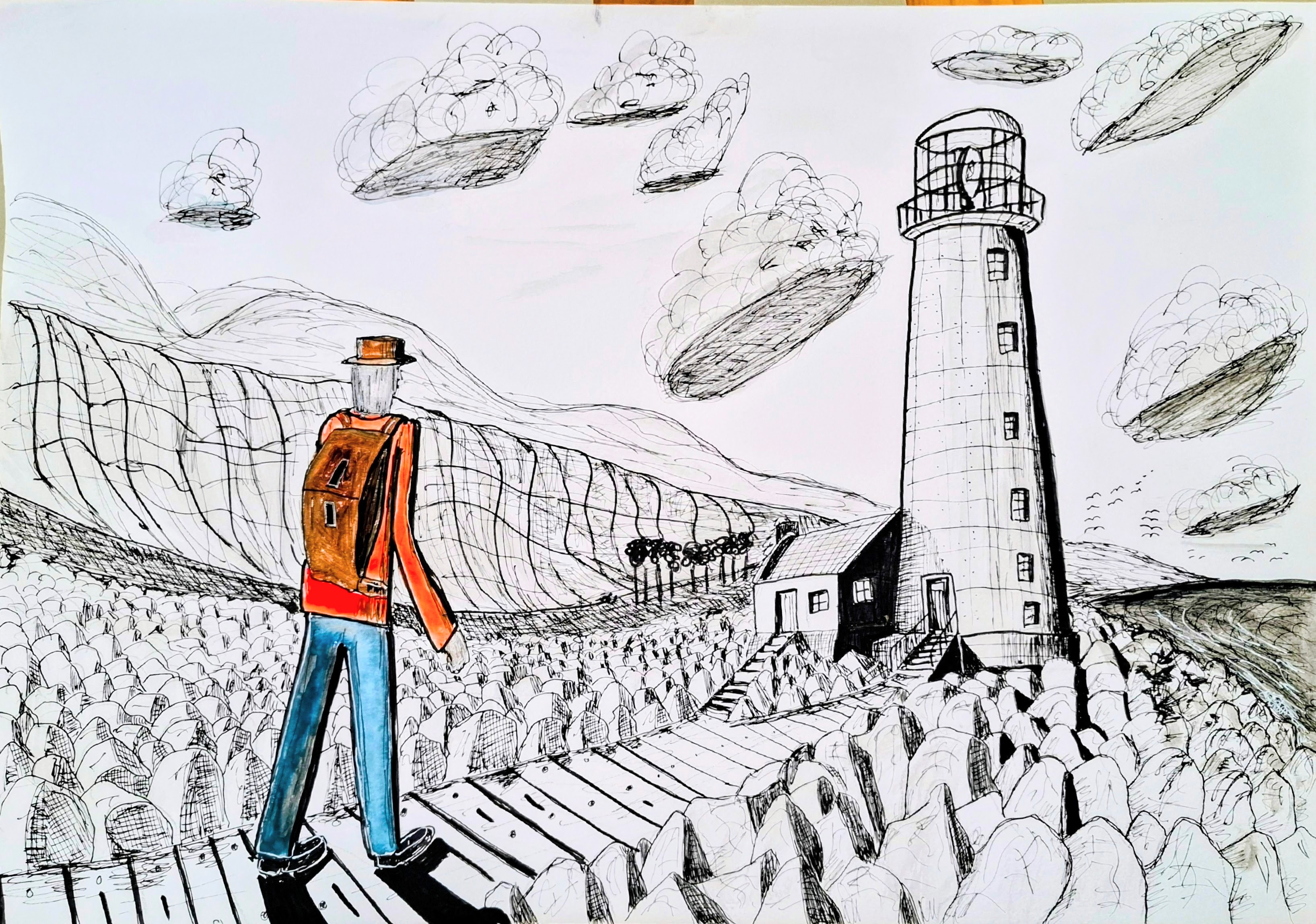
A Lighthouse to Know Where takes him out of the town. A boardwalk runs across a field of stones to a lighthouse on the headland, and the saucer clouds that have drifted through the whole series are massed overhead, heavier here, low over the hills. A lighthouse is the honest version of a destination. It is not the end of the journey. It is a fixed light that tells you where you are and warns you off the rocks, and then you keep going. He walks the planks toward it with the same pack and the same colour, and the light is something to steer by, not something to reach.
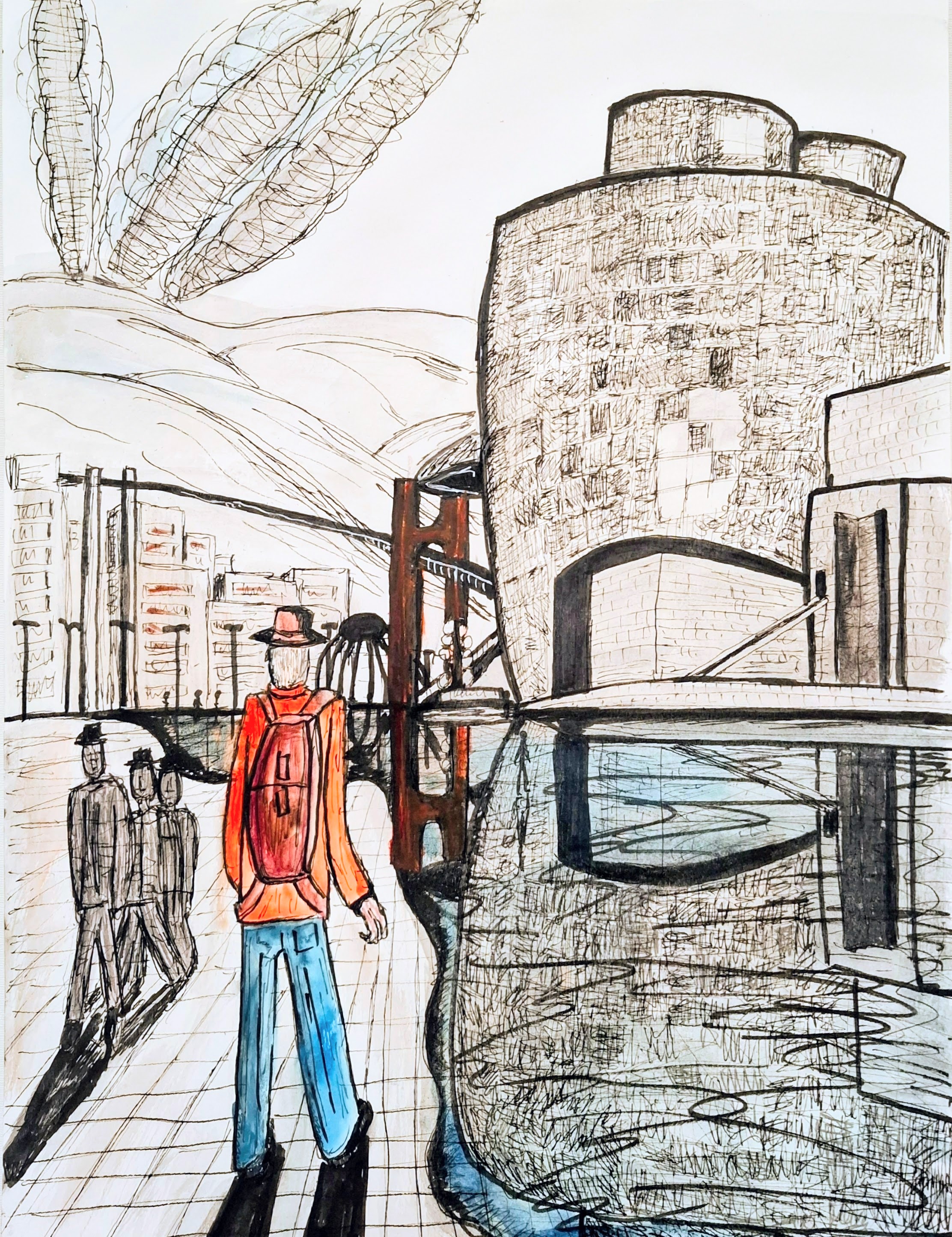
A Reflection on Know Where brings him to water in a city. A titanium building curves on the far bank, a red bridge crosses behind him, the towers of the place stack up on the left, and three grey figures walk the other way. The near half of the picture is the city. The far half is the city again, upside down in the water, softer and less certain. That is the point of the reflection. He has walked far enough to look back at where he has been, and what he sees is a version of it, held in the surface, true enough to recognise and not solid enough to stand on. He is still facing forward.
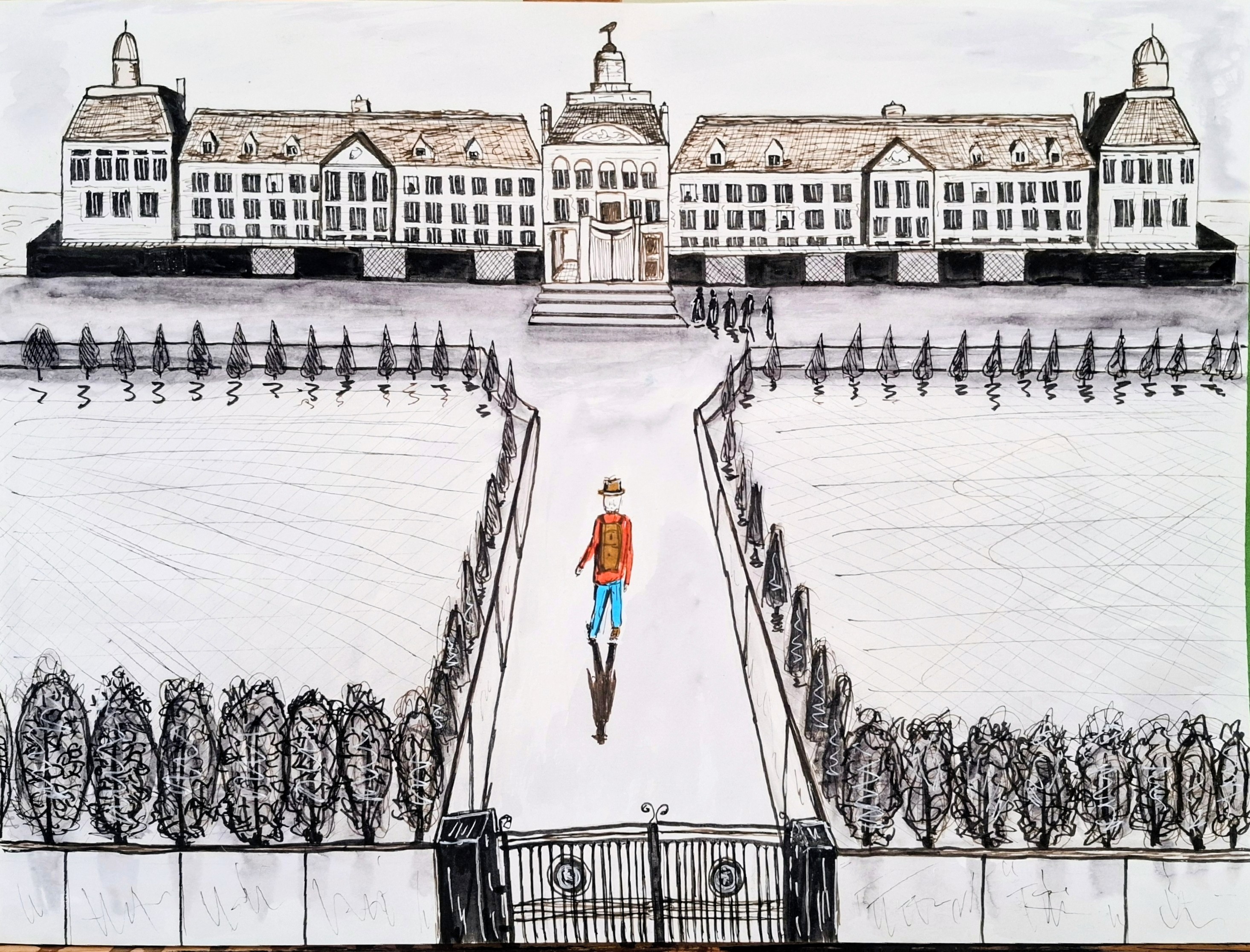
Know Where My Mind's At is the fifth drawing. The town is behind him. He walks a straight path up the middle of a formal garden toward Bedlam, clipped trees in rows on either side, an iron gate closed at his back, the grand symmetrical hospital across the far end with a handful of figures gathered at its door. Everything in the picture is ordered. The planting is measured, the building is balanced, the avenue points him at the entrance and gives him nowhere to wander. He is still the only colour, still small against it, still walking.
The title is the joke the series keeps making, and this time it turns inward. The other drawings ask where the road goes. This one asks where his head is while he walks it, and answers with Bedlam. The word means chaos, but the place he is walking into is all order: a calm facade, a level garden, a gate that shuts behind you. That is the unease of it. The asylum is the tidiest thing in the series, and it is still the asylum. Knowing where your mind is turns out to be its own kind of destination, and it is not a comfortable one to arrive at.
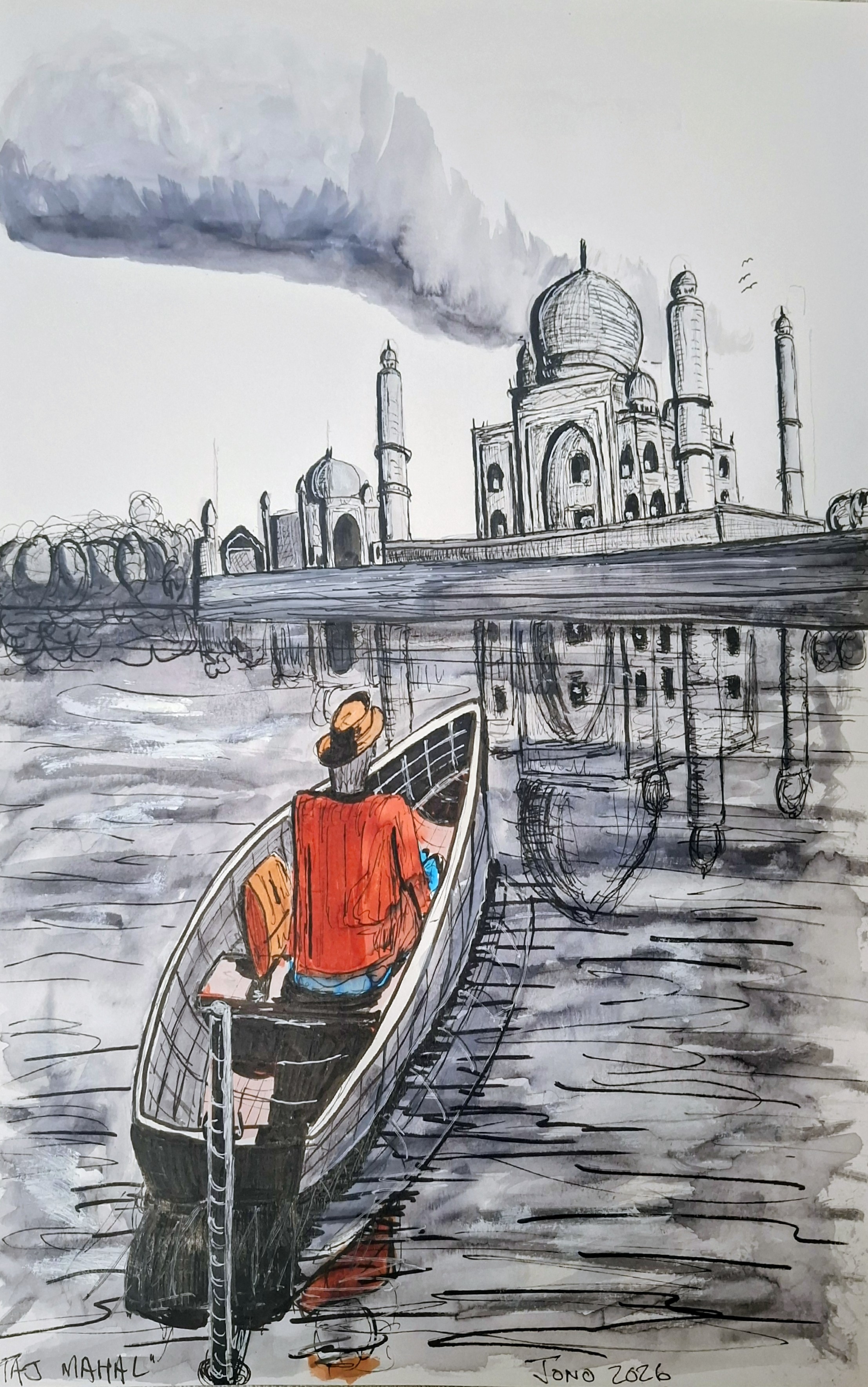
Taj Mahal is the sixth drawing, and it breaks the rule the series had kept until now. He is sitting down. He is in a moored boat on the river with his back to me, the same red top and the same hat, the pack propped beside him, and the mausoleum stands on the far bank with its dome and its four minarets, doubled in the water underneath. The sheet is grey scribble and wash from top to bottom. He is still the only colour, and for once he is not moving.
I did not plan the reversal, it came out of the subject. The Taj is a tomb. A man built it for his wife and it is now the most photographed destination on earth, which are two facts that sit awkwardly together and both belong in the picture. You cannot arrive there and expect the road to carry on. It is the end of somebody's journey, permanently, and the building says so in white marble. So the pilgrim gets to it and stops, and the drawing puts him in a boat rather than on a path, which is the one place in the series where his feet are no use to him.
The dark cloud across the top is the part I am least sure of and kept anyway. It runs in from the left over an otherwise empty sky, and it is the only thing in the drawing that is going anywhere. Read it as weather if you like. It is more useful as the thing still travelling while he sits.
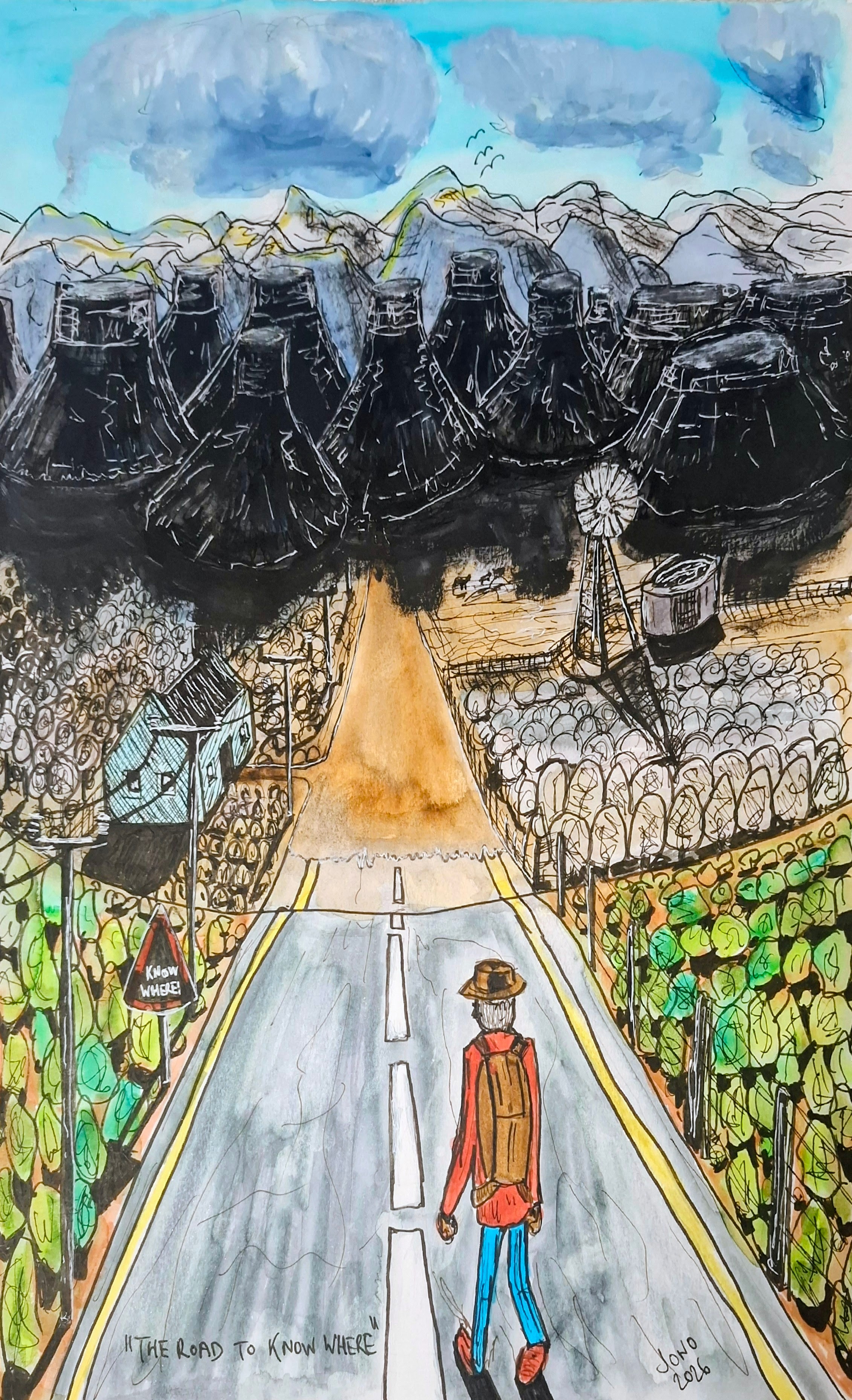
The Road to Know Where Revisited is the seventh drawing and it puts him back where he started. A road running away from the viewer, vineyards banked up on both sides, a windmill on the right, a KNOW WHERE sign at the verge in the shape of a warning triangle. He walks the centre line with his back to me. The mountains close the distance, and the dark shapes massed under them could be cooling towers or could be hills, and the drawing does not settle it.
Coming back to the road after the boat is the closest the series has to an argument. He sat down once, in front of the finest destination anyone has built, and then got up and went back to the middle of a road with a sign on it that names the place and still does not tell you where it is.
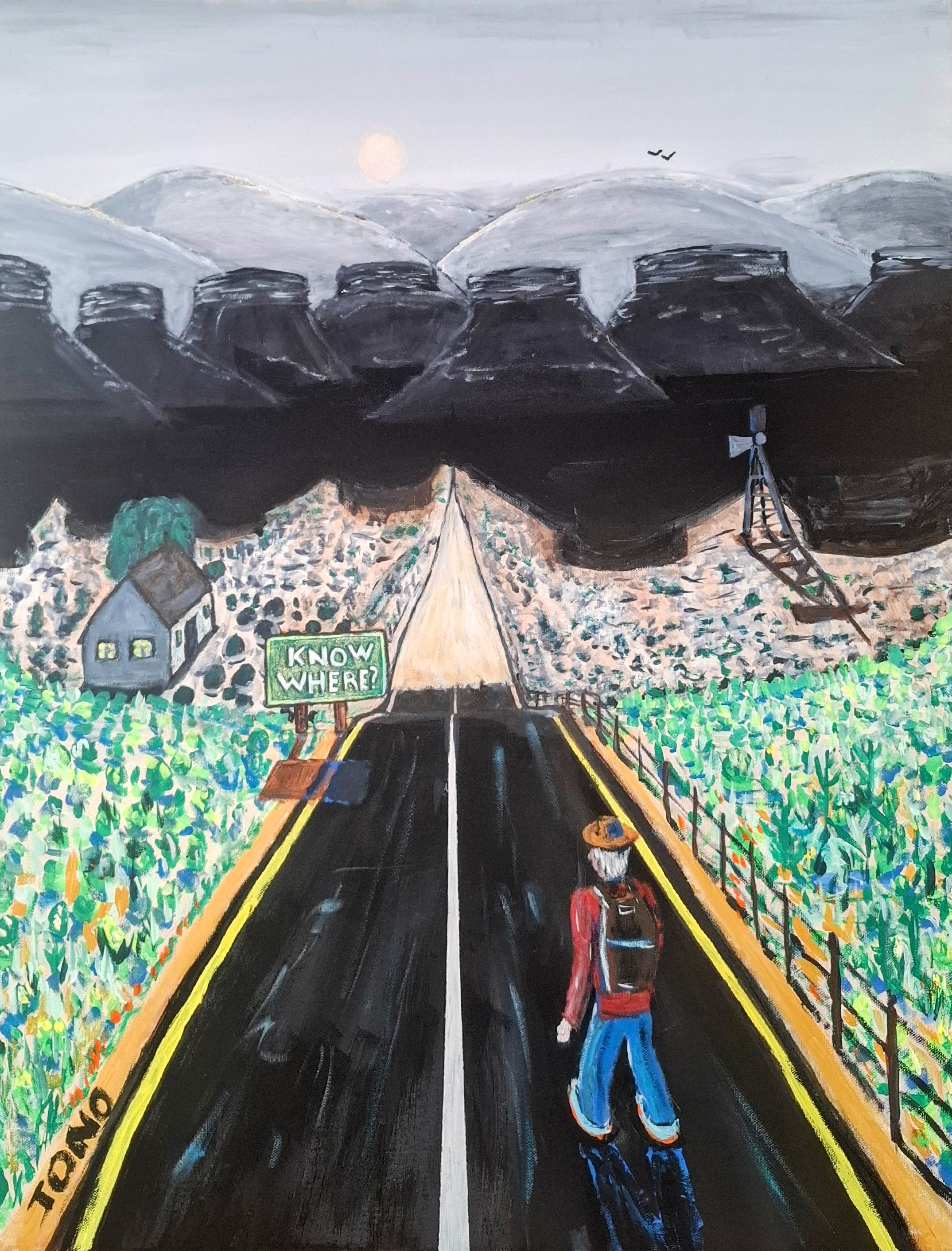
The Road to Know Where is the second painting and it takes that seventh drawing as its blueprint. Same road, same centre line, same KNOW WHERE sign at the verge, same windmill on the right. What changes is the scale and the colour. The drawing was A3 and mostly grey. This is A2 in acryla gouache on canvas board, and the colour is let out across the whole surface instead of being held back for one figure.
That was the rule I broke to make it. Through seven drawings the pilgrim was the only thing given colour, and the series ran on that. Here the orchards are yellow and orange to the edge of the picture, the vine rows burn red where they meet the dark, and he is one red coat in a field of them. He is no longer the exception. He is a man walking through a place as alive as he is, and he has to hold his own against it.
The shapes under the mountains are still unresolved, and they carry more weight in paint than they did in ink. Cooling towers, or hills, or hills that have become cooling towers. They are laid in flat and black right across the horizon, and the road runs straight into them. Everything in front of that line is fruit and light. Everything behind it is not. He is walking towards the part of the picture I cannot name.
The sign still says KNOW WHERE. It still does not say where.
On the Way to Know Where is the third painting and the tenth work in the series, and it is the first time something gets in his way. He is in the main street of a small town. A flock of sheep has come down through the centre and filled the road from the shopfronts to the hotel wall, and everything has stopped. A police car sits across the tar. He is on the pavement at the bottom right with his pack and his hat, waiting, which is not something he has done before.
The town is loosely De Rust, which sits on the R62, the same road that gave me The Road to Somewhere (Part One). The name is Afrikaans for the rest, and I did not pick it for that, but it is the joke the painting ended up making. The one place on the route named after stopping is the place where he is made to stop.
Everything the series has put in front of him until now has been distance: a square to cross, a boardwalk, an avenue, a road running out to the horizon. This is the first obstruction with a mind of its own, and it is sheep. Not weather, not a shut gate, not the dark under the mountains. A flock moving at its own pace through a town that has no choice but to wait for it. The delay is nobody's fault and nobody can shorten it.
The police car is the part I like most. Somebody called them, they came, and the problem is entirely beyond them. You cannot reason with a flock. They can put a car across the road and stand next to it, and the sheep will clear when the sheep clear. It is the most honest thing I have painted about authority: present, willing, and no use at all to the actual difficulty.
The petrol station on the left and the hotel on the right are the two things a road town sells, fuel to carry on with or a bed to stop in, and he is walking between them and taking neither. The mountains are up behind the roofs in green and red, unbothered, and the road carries on through the town and out the far side. He is not on the road in this one. He is on the way, which is a different thing, and slower.
The journey has no endpoint yet. That is not a failure of the series, it is the subject of it. The pilgrim has crossed a square, a street, a headland, a waterfront, a formal garden and a river, and the one time he sat down, in front of a tomb, he got up again and went back to the road. The series opens with a painting of the place he is trying to reach. Nine works later it arrives at a painting of him standing in a main street behind a flock of sheep, going nowhere for the moment, still facing the right way. The destination stays one picture ahead.