Aeromechanica
The War Sheets, 1941 to 1945
The Commercial Sheets, 1958 to 2026
I did not set out to invent a company. I set out to draw a beetle with a bomb bay. The company assembled itself out of the paperwork, because once you letter a title box and rule a data panel you have implied a drawing office, and a drawing office implies someone paying for it.
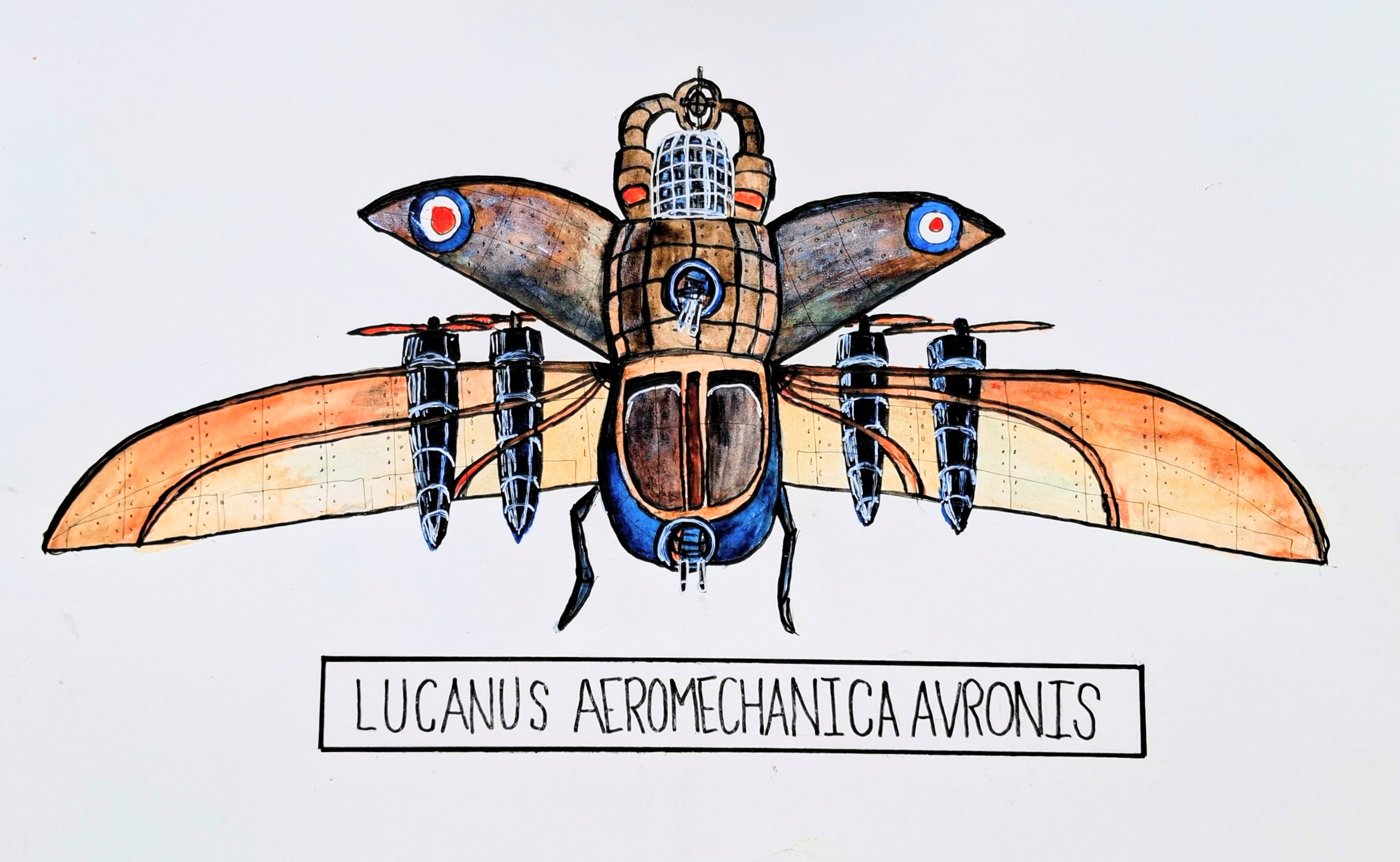
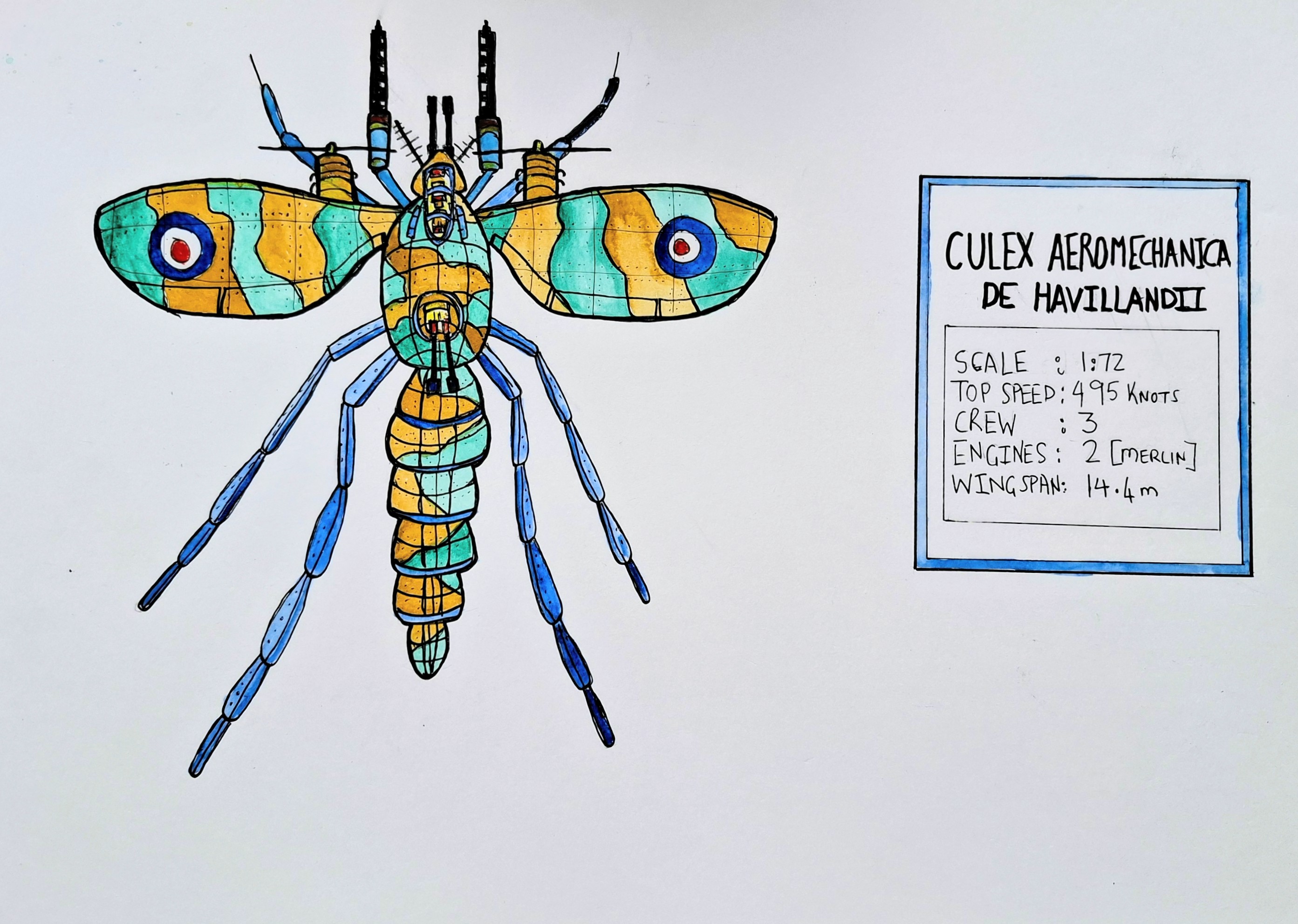
The first sheets are wartime identification plates. That is the format they arrived in and I never argued with it. A single specimen centred on white, plan view, wings out, hand lettered name in a ruled box underneath. Lucanus Aeromechanica Avronis is a stag beetle wearing an Avro, mandibles raised, roundels on the wings, four bombs slung underneath and a glazed turret where the head should be. Culex Aeromechanica De Havillandii is the joke I built the whole thing on. The De Havilland Mosquito was named after the insect. I have simply named the insect back, and given it two Merlins, three crew and a 14.6 metre span in a data box in the corner. The box says scale 1:72, which is a model kit scale, not a specimen scale. Aircraft recognition chart, natural history plate and Airfix lid are the same document. They always were.
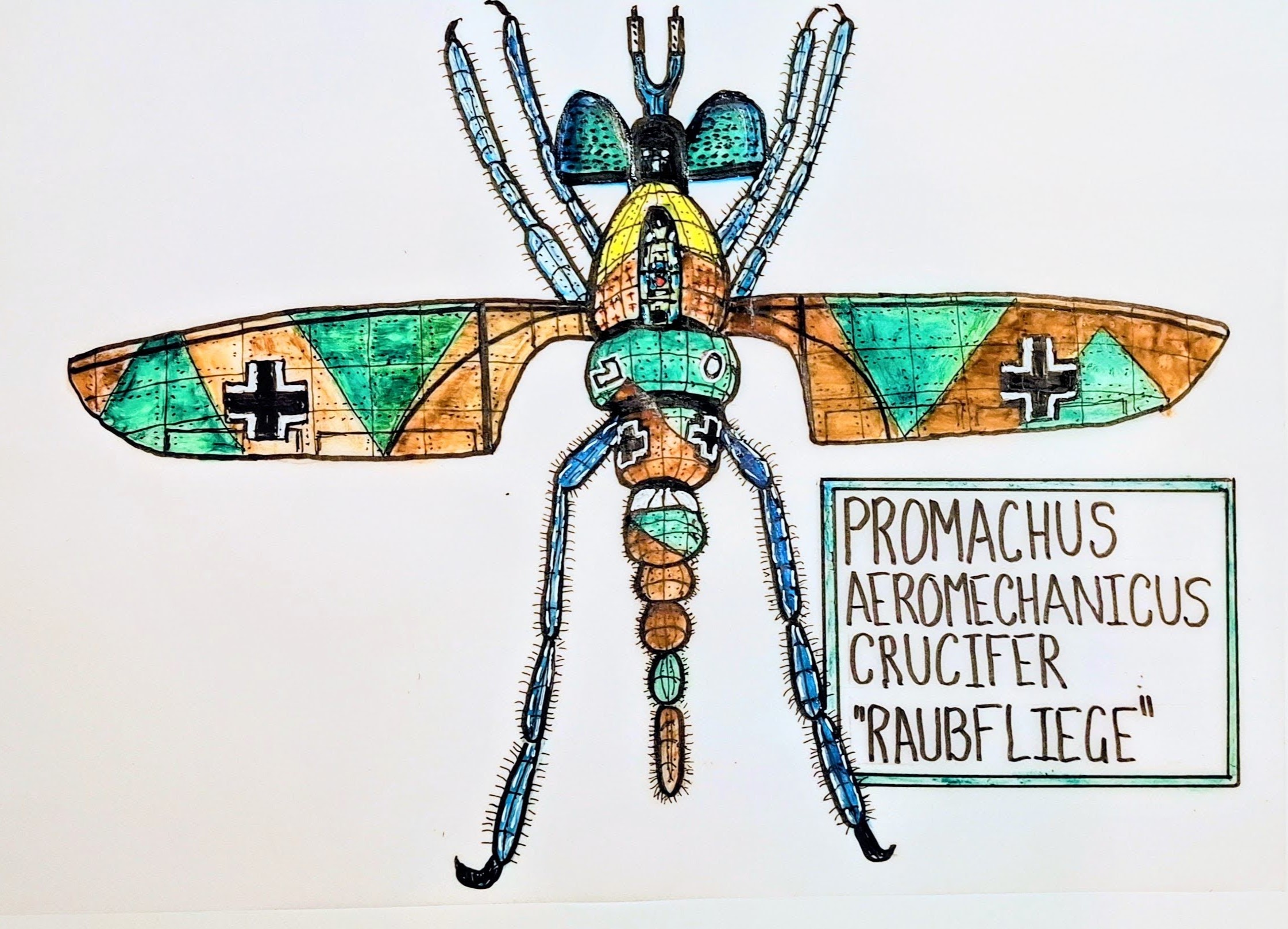
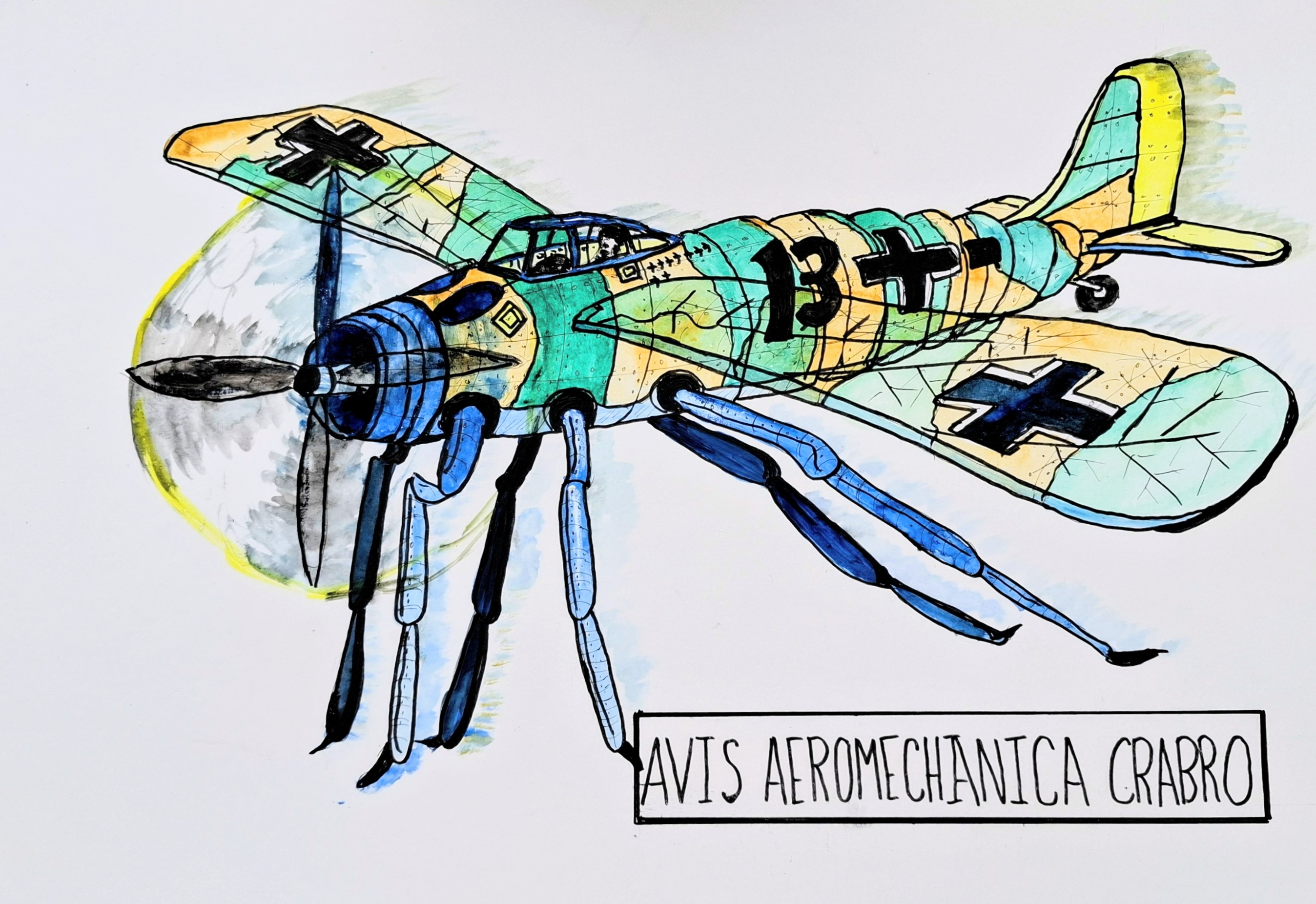
Then there is the other half of the drawer. Promachus Aeromechanicus Crucifer is a robber fly in splinter camouflage with Balkenkreuze on the wings, and the title box carries a German nickname, Raubfliege. Vespa Aeromechanica Crabro is a hornet built onto the nose of a Bf 109, striped abdomen for a rear fuselage, six blue legs hanging where the gear should be, fuselage code painted on the side. Same hand, same ink, same ruled box, same 1:72. The sheets do not take a side. They cannot, because whoever drew them supplied both, and an identification plate for the enemy is worth exactly as much as one for your own squadron. That is not a moral position. It is a market.
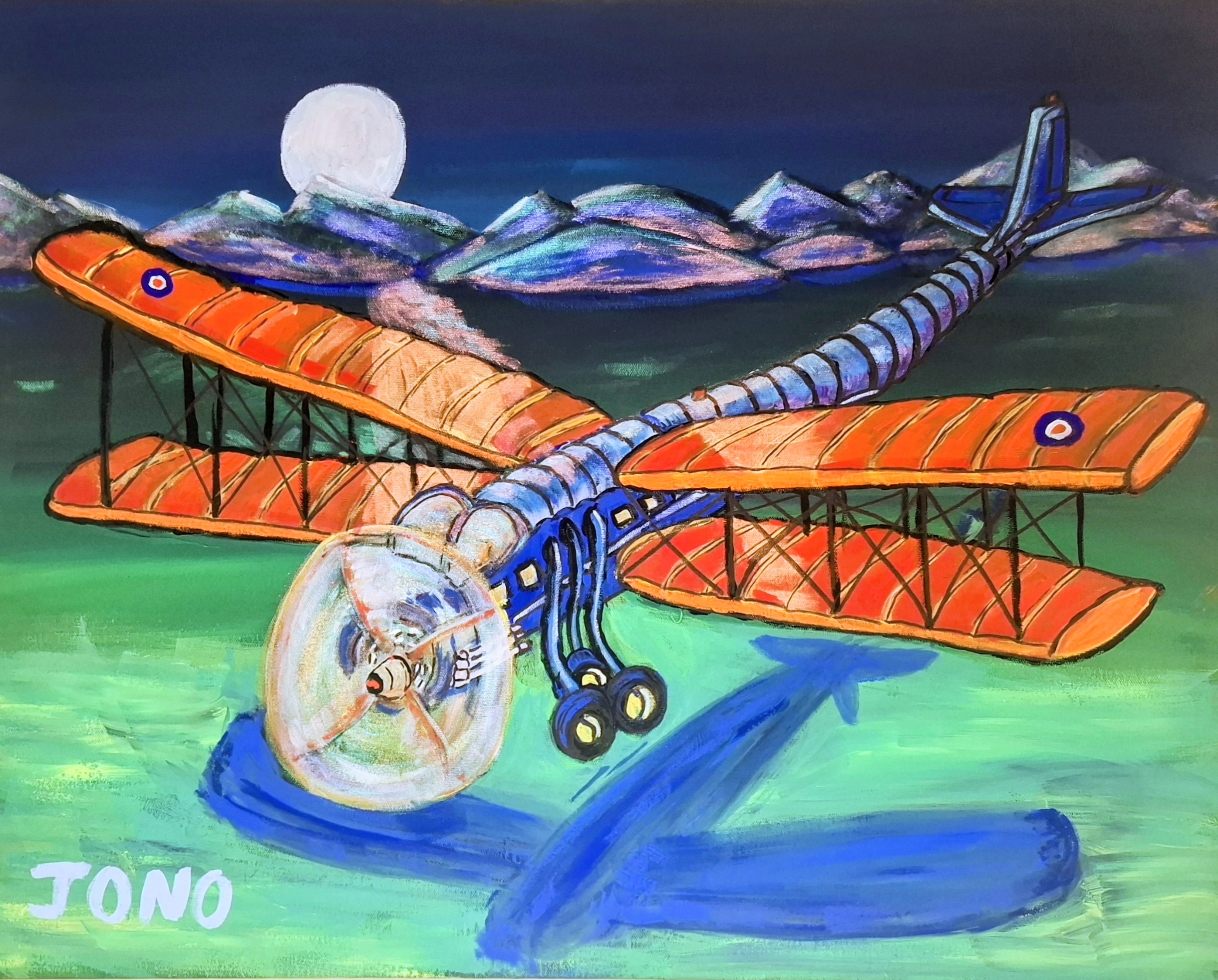
Libellula Aviatica is the one that escaped the drawer. A dragonfly given a biplane, orange wings on their struts, roundels, a twin tail, painted in acrylic under a full moon over green water with its shadow underneath. It is the only wartime piece with weather in it, and it is the point where I stopped drawing evidence and started painting an aircraft.
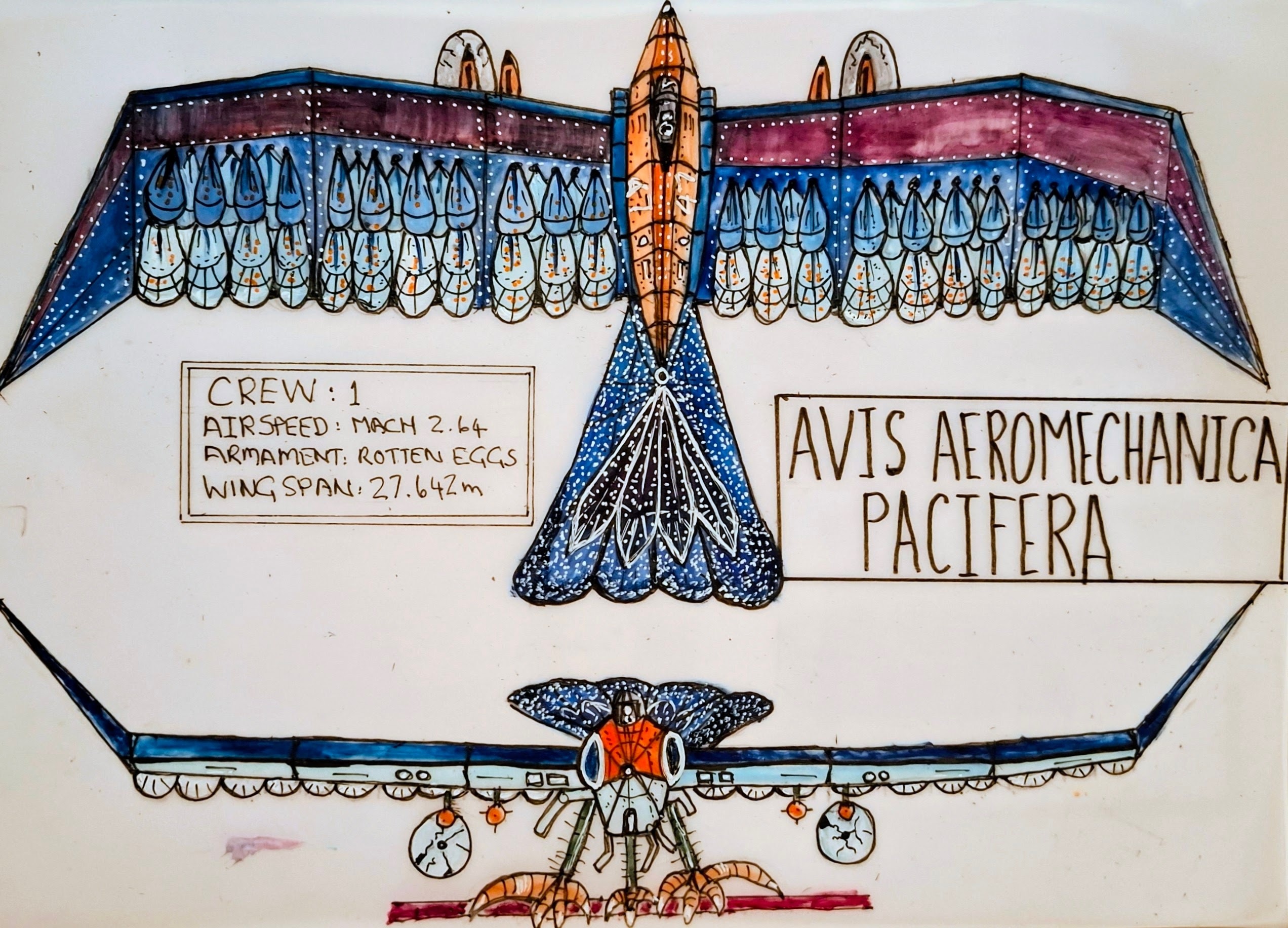
Avis Aeromechanica Paciferus is the jet age and the end of the war business. Swept gull wings, 27.642 metres of span, Mach 2.64, crew of one, drawn twice on the sheet in plan and front elevation like a manufacturer's brochure. Two things are missing. There are no national markings anywhere on it, and the armament line reads rotten eggs. A firm that spent the war lettering roundels and crosses onto the same drawing paper has taken the markings off, put a peace-bearing name on the nose, and armed it with something that can only humiliate you. That is the pivot, and it is done with a straight face.
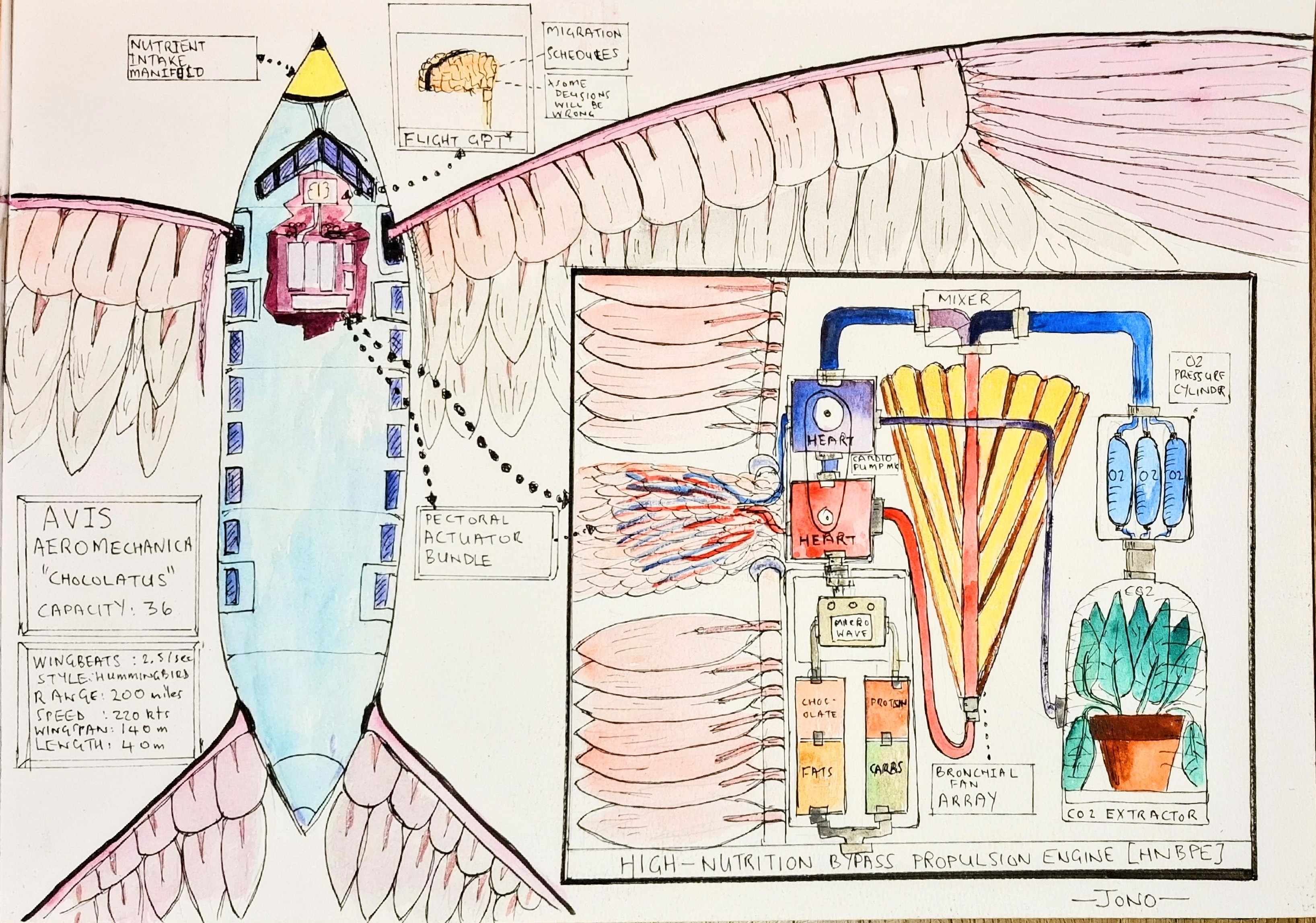
After that it goes commercial, and the drawings change character completely. The top profile is a proper specification sheet: capacity 36, range 200 miles, cruise 220 knots, 2.5 wingbeats a second, style listed as hummingbird. Alongside it, drawn out in full, the High-Nutrition Bypass Propulsion Engine, two hearts, a turbo pump, a mixer, oxygen cylinders, feed lines labelled chocolate, protein, fats and carbs, a bronchial fan array, and a CO2 extractor drawn as a plant in a terracotta pot. Thirty-six seats and two hundred miles is not a flagship. It is a regional aircraft, and every airline in history has started with one.
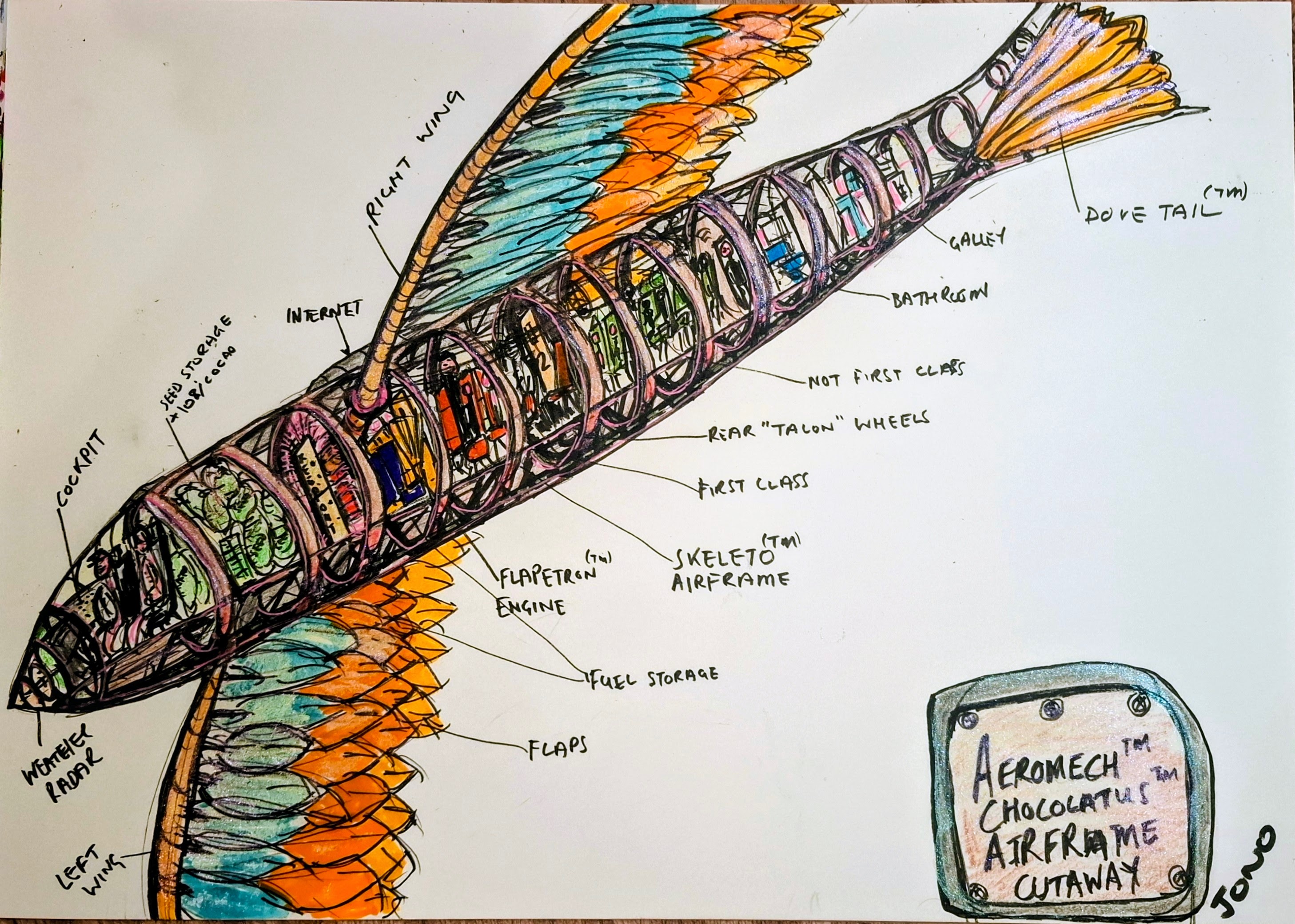
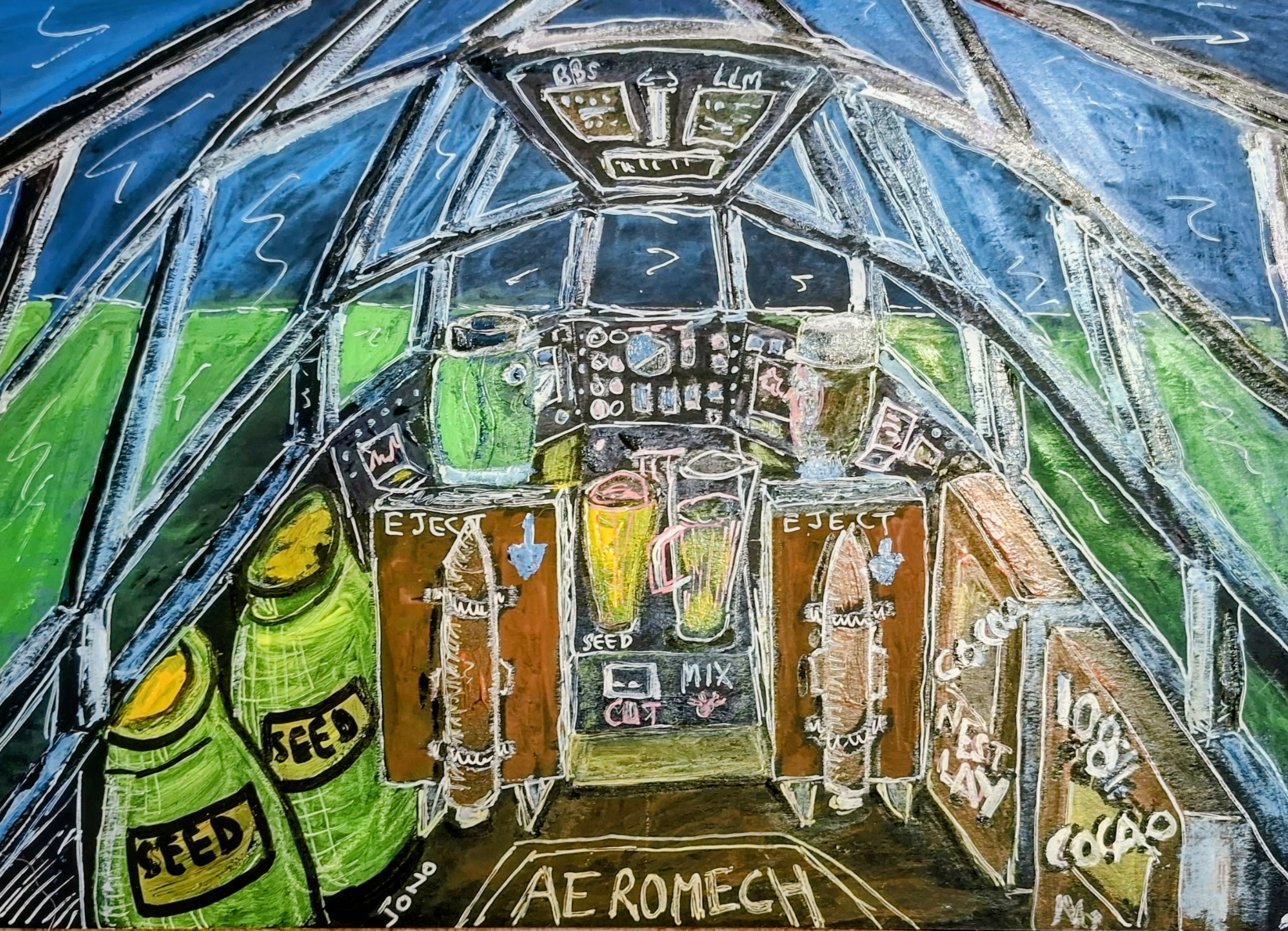
The cutaway is where the company stops being a joke about war and becomes a joke about business. The title block reads Aeromech, with a trademark symbol, and so does half the aircraft. Skeleto airframe. Flaperon engine. Dove Tail. Somebody in that office has been through the registration process for a tail. The cabin is sectioned like any airliner cutaway, and the labels run first class, then not first class, then galley, bathroom, fuel storage, internet, rear talon wheels. There is a class system in a bird. The cockpit sheet finishes it: two seats, an eject lever each, sacks of seed stacked against the bulkhead, drums of 100% cocoa, a row of smoothie glasses on the centre console, controls marked seed, mix and cut, and Aeromech lettered across the sill where the airline name goes.
Nothing on any of those sheets explains what actually flies the thing. The engine plate gives you the plumbing, the cutaway gives you the seating, the cockpit gives you three levers and a row of glasses, and none of it accounts for five hundred seats of animal holding a stable cruise at altitude. That part is FlightGPT, and it is not drawn because it has no shape. Aeromech took the thing a bird already knows, the part that keeps a starling inside a murmuration without a single instruction being issued, and ran a large language model on top of it. The bird flies. The model explains the flying.
That division is the entire product. A bird has never once completed a form. A language model will complete any form you put in front of it and has never been off the ground. Put the two in the same airframe and you have something that stays up and something that can account for itself afterwards, which is the only combination anyone certifies. The trademark on the cutaway sheet sits on the airframe and the engine. The certificate sits on what the model writes about them.
Passengers get the other half, and Aeromech sells it as the flight experience. Announcements composed fresh for the weather. A voice that tells you what the bird can see before you see it. Turbulence described as intention rather than accident, so the drop you just felt was a decision taken on your behalf by something with better eyes. It is genuinely good, and it is entirely downstream. The model is not flying, it is narrating, and I have sat in enough rooms to know how fast a fluent account of the work gets promoted to the work.
Which leaves the failure case, and it is the line I would put in the manual and no airline would print. When the bird and the model disagree, the bird is right and the model is confident. There is no lever on the cockpit sheet for that.
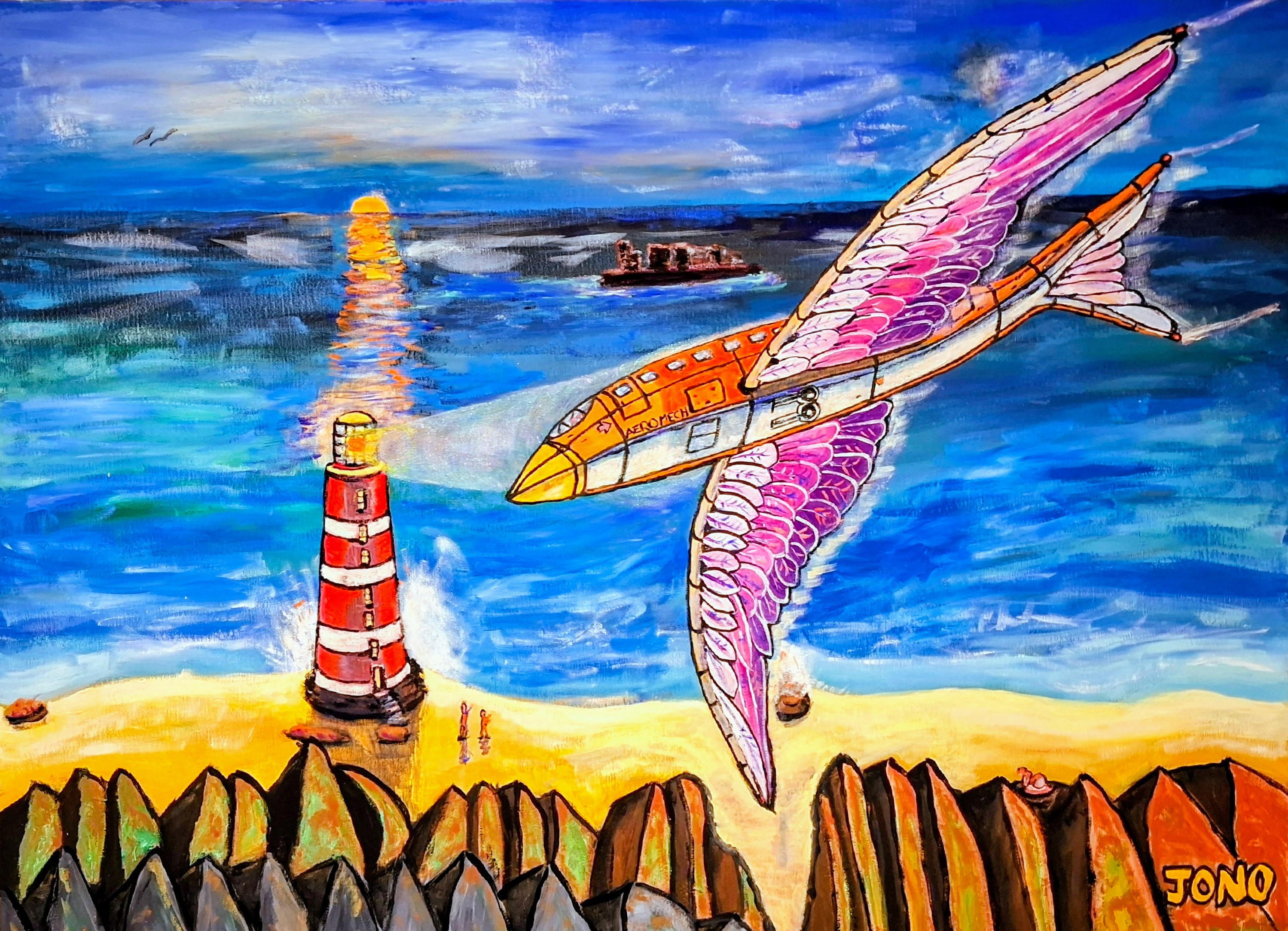
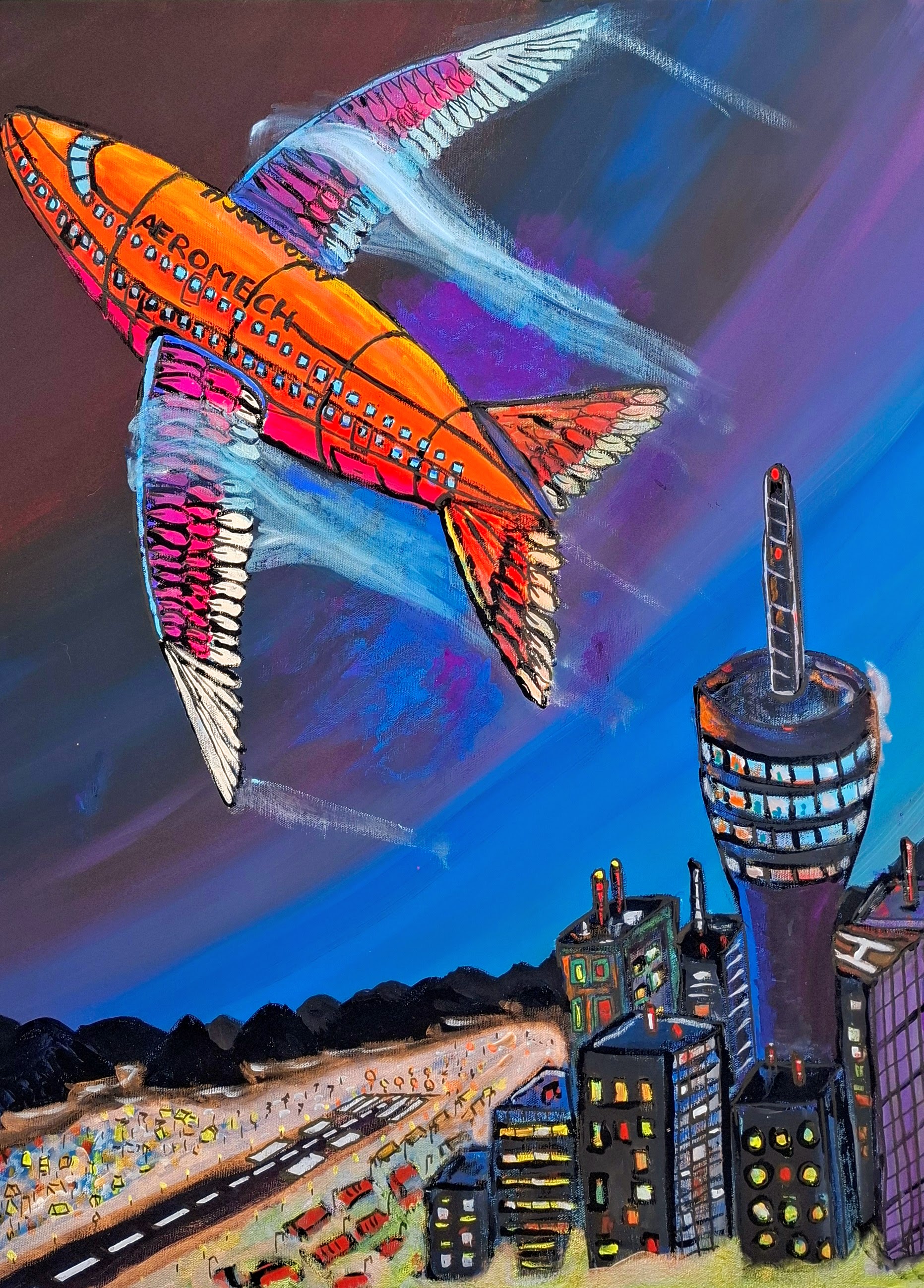
Then the two paintings, which are the advertising. Avis Aeromechanica Chocolatus passes a red and white banded lighthouse at sunset with the light running gold across the water and a container ship on the horizon, pink feathered wings out and passenger windows down the fuselage. Aeromechanica Musculus is the flagship, whale sized, five hundred seats, Aeromech painted along an orange double-decker fuselage, climbing away from a city at night with the motorway lit underneath. That is a route map. Coast in the evening, metropolis after dark. Every airline in the world sells the same two pictures.
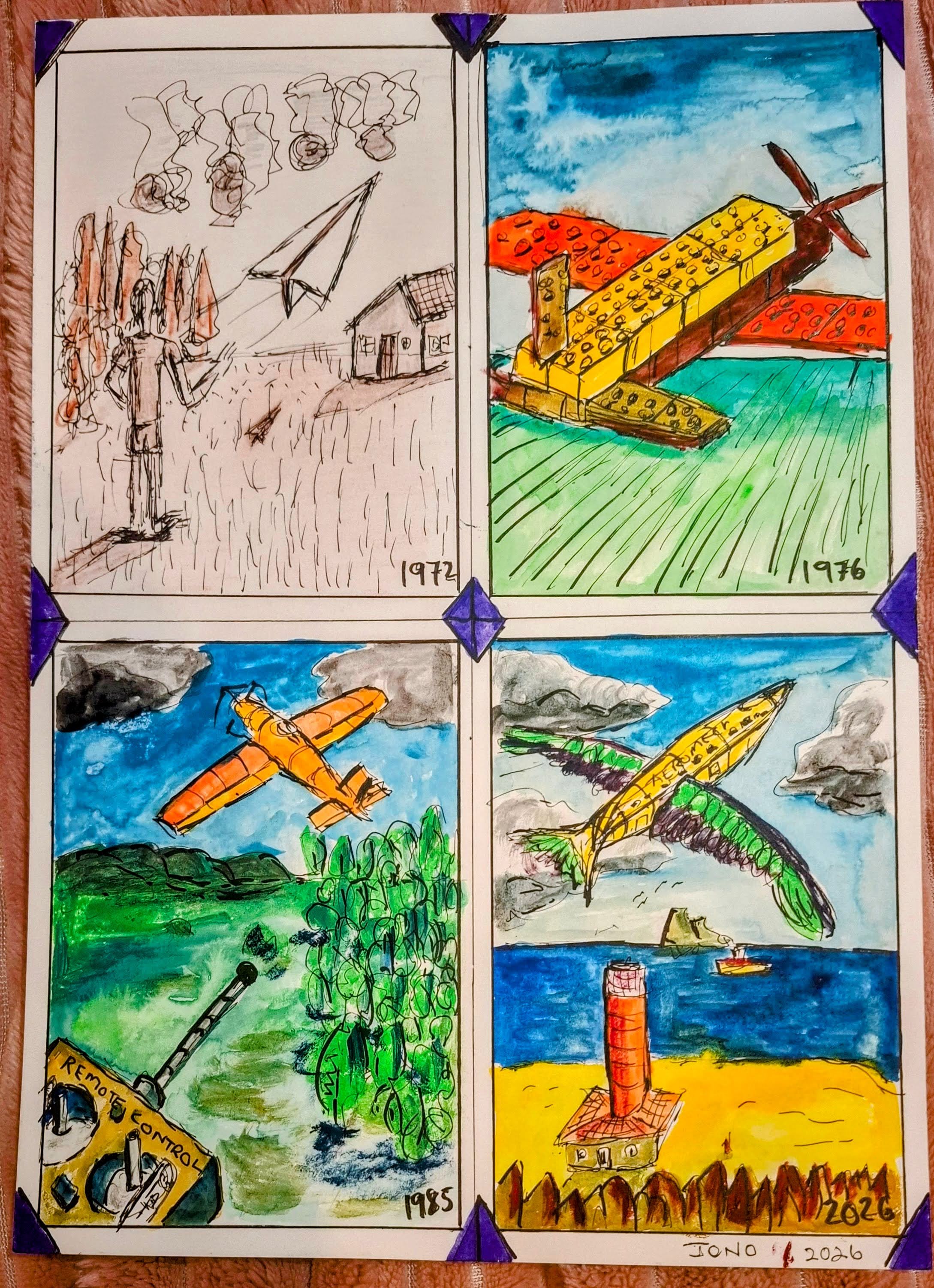
And then the last sheet, which undoes all of it. Evolution is four panels held down with purple photo corners, like a page lifted out of an album. 1972: a boy in a field throwing a paper aeroplane at a house. 1976: an aircraft built out of toy bricks. 1985: a remote control model over a field with the transmitter drawn in the corner. 2026: the biomechanical bird over the lighthouse and the beach, which is the Chocolatus painting, in miniature, at the end of its own family album.
So the company history is a lie and the album is the truth. There was no drawing office and no wartime contract, there is one person who has been making aircraft since he was small and got better paper. I like the corporate version because it lets me keep drawing the parts, and the trademark symbols and the class system and the cocoa reserves are all things I have watched real firms do with a straight face. But the reason the wings are covered in feathers rather than rivets is the boy in the first panel, and he was not trying to build an airline. He was trying to get something to stay up.