The Wish That Scales
There is a class of hope that does not fit at human scale. World peace. Climate stability. More love in circulation. Each of them is reasonable. Each of them is also too large for any one person to hold. The standard adult responses are irony, paralysis, or quiet abandonment. None of those work either.
One of my paintings sits in that uncomfortable place. The Love Vending Machine, a 1500 by 2000mm canvas where positive energy is dispensed from the Universe into human hands. It takes a wish that is too big to carry, and treats it as if a method exists. The method is absurd. The wish is not.
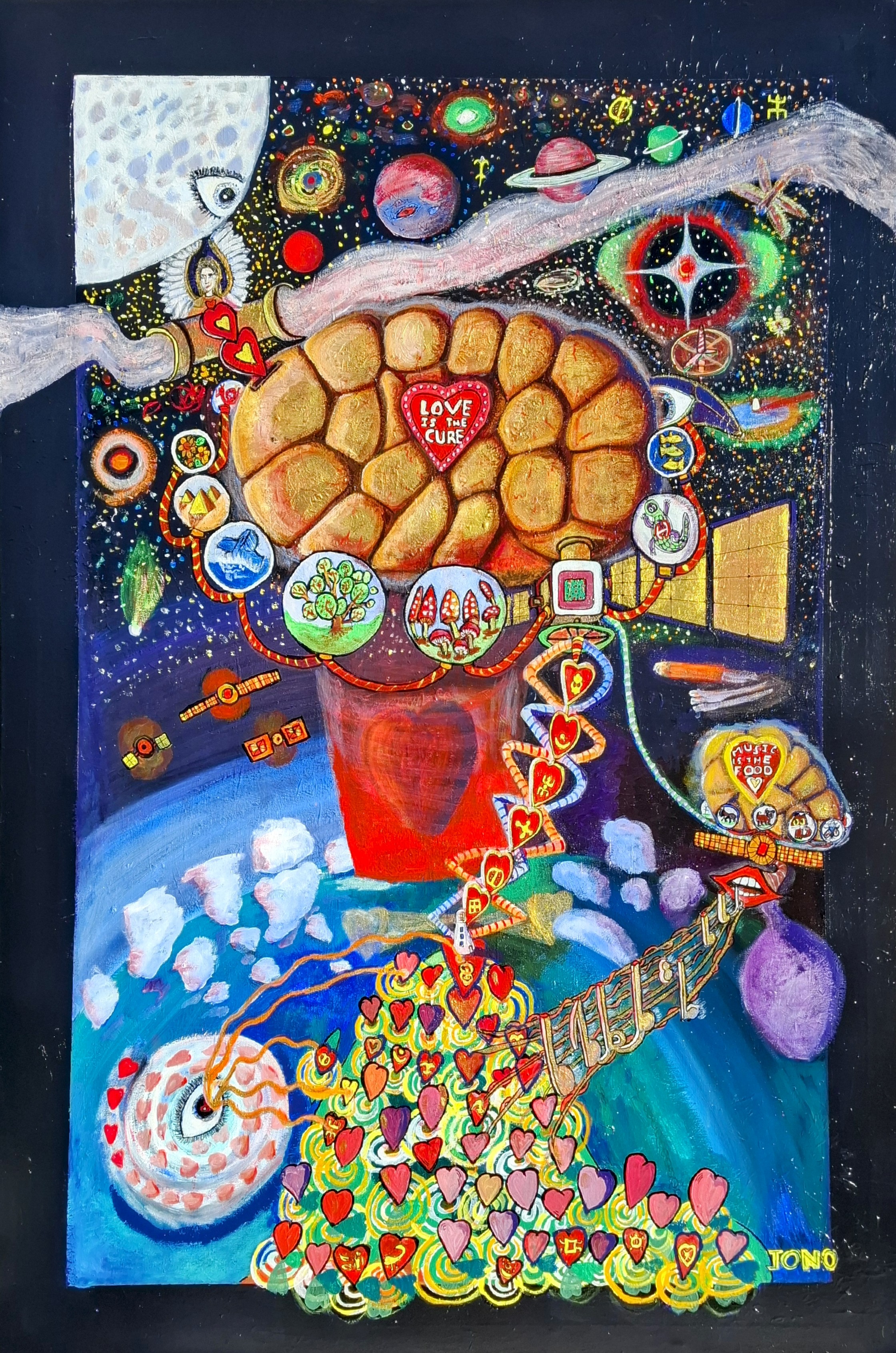
The Love Vending Machine
The wishes are not the problem
It is fashionable to treat large hopes as naive. Adults are supposed to scale their ambitions down to what they can deliver. Climate hope becomes a series of small consumer choices. Peace becomes diplomatic process. Love becomes the people in the next room. There is a sense in which that is correct, and a sense in which it is the source of the problem.
A wish at world-scale is the only wish proportionate to a world-scale problem. World peace is the only condition that ends the recurrent collapse of all the smaller settlements. Love at scale is what every credible religious tradition has asked for, and what every successful one delivers in some form. These wishes are not childish. The childish move is to pretend they are not necessary.
The method is the giveaway
What is wrong with this painting, as a practical proposal, is the method. Vending machines do not dispense love.
That is the painting telling on itself. The method is wrong on purpose. The painting is not a manual. It is the visible shape of a wish that has nowhere reasonable to land. The Universe in The Love Vending Machine is doing the work because no human institution will.
That is not a flaw in the wish. It is a description of where we are.
Why the smirk is the wrong response
The default register of contemporary culture for hopes of this size is the smirk. Yes, world peace, sure. Yes, more love in the world, very sweet. The smirk is a way of acknowledging the wish without committing to it, which is to say a way of betraying the wish while claiming to honour it.
I am not religious in any organised sense, and I am not optimistic by temperament. I am sceptical of grand schemes, including the ones I paint. I have spent enough time around enterprise governance to know how slowly anything actually changes, and how often the people promising to change it are the obstacle.
The painting is not arguing that the wish will be fulfilled. It is arguing that the wish deserves to be held without irony. That is harder than it sounds.
If that reads as naive, I am content with the charge. Naive art is allowed to take things at face value. It is one of the few permissions still available.
What the painting asks of you
Standing in front of The Love Vending Machine, the question is not whether the device works. It is whether the world it imagines is desirable. If it is, the painting has done its job. The mechanism is a placeholder for whatever real mechanism would be required, and that real mechanism has not yet been invented.
What I am not arguing
I am not arguing that wishing makes a thing happen. The painting knows better than that.
I am also not arguing that scale-wishing is a substitute for the small, boring, unglamorous work of diplomacy, of policy, of the kindness in the next room. It is not. Those are the actual paths, when they are paths at all.
What I am arguing is that the wish has a function. It anchors the work. It tells you what direction the small things are supposed to add up to. Without the wish at the top, the small things drift. With the wish, they are at least pointed at something worth arriving at.
Endpoint
You can keep your hopes small and have them fulfilled. You can hold larger hopes and watch them fail in detail, repeatedly, for a lifetime. The first is more comfortable. The second is the only one proportionate to the size of what is actually wrong.
This painting is for the second.
This is a personal essay. The views are my own.